Showing posts with label papers. Show all posts

2017-09-09

Stocator: A High Performance Object Store Connector for Spark


Behind Picton Street

IBM have published a lovely paper on their Stocator 0-rename committer for Spark

Stocator is:
  1. An extended Swift client
  2. magic in their FS to redirect mkdir and file PUT/HEAD/GET calls under the normal MRv1 __temporary paths to new paths in the dest dir
  3. generating dest/part-0000 filenames using the attempt & task attempt ID to guarantee uniqueness and to ease cleanup: restarted jobs can delete the old attempts
  4. Commit performance comes from eliminating the COPY, which is O(data),
  5. And from tuning back the number of HTTP requests (probes for directories, mkdir 0 byte entries, deleting them)
  6. Failure recovery comes from explicit names of output files. (note, avoiding any saving of shuffle files, which this wouldn't work with...spark can do that in memory)
  7. They add summary data in the _SUCCESS file to list the files written & so work out what happened (though they don't actually use this data, instead relying on their swift service offering list consistency). (I've been doing something similar, primarily for testing & collection of statistics).

Page 10 has their benchmarks, all; of which are against an IBM storage system, not real amazon S3 with its different latencies and performance.

Table 5: Average run time


Read-Only 50GB
Read-Only 500GB
Teragen
Copy
Wordcount
Terasort
TPC-DS
Hadoop-Swift Base
37.80±0.48
393.10±0.92
624.60±4.00
622.10±13.52
244.10±17.72
681.90±6.10
101.50±1.50
S3a Base
33.30±0.42
254.80±4.00
699.50±8.40
705.10±8.50
193.50±1.80
746.00±7.20
104.50±2.20
Stocator
34.60±0.56
254.10±5.12
38.80±1.40
68.20±0.80
106.60±1.40
84.20±2.04
111.40±1.68
Hadoop-Swift Cv2
37.10±0.54
395.00±0.80
171.30±6.36
175.20±6.40
166.90±2.06
222.70±7.30
102.30±1.16
S3a Cv2
35.30±0.70
255.10±5.52
169.70±4.64
185.40±7.00
111.90±2.08
221.90±6.66
104.00±2.20
S3a Cv2 + FU
35.20±0.48
254.20±5.04
56.80±1.04
86.50±1.00
112.00±2.40
105.20±3.28
103.10±2.14

The S3a is the 2.7.x version, which has the stabilisation enough to be usable with Thomas Demoor's fast output stream (HADOOP-11183). That stream buffers in RAM & initiates the multipart upload once the block size threshold is reached. Provided you can upload data faster than you run out of RAM, it avoids the log waits at the end of close() calls, so has significant speedup. (The fast output stream has evolved into the S3ABlockOutput Stream (HADOOP-13560) which can buffer off heap and to HDD, and which will become the sole output stream once the great cruft cull of HADOOP-14738 goes in)

That means in the doc, "FU" == fast upload, == incremental upload & RAM storage. The default for S3A will become HDD storage, as unless you have a very fast pipe to a compatible S3 store, it's easy to overload the memory

Cv2 means MRv2 committer, the one which does  single rename operation on task commit (here the COPY), rather than one in task commit to promote that attempt, and then another in job commit to finalise the entire job. So only: one copy of every byte PUT, rather than 2, and the COPY calls can run in parallel, often off the critical path

 Table 6: Workload speedups when using Stocator


Read-Only 50GB
Read-Only 500GB
Teragen
Copy
Wordcount
Terasort
TPC-DS
Hadoop-Swift Base
x1.09
x1.55
x16.09
x9.12
x2.29
x8.10
x0.91
S3a Base
x0.96
x1.00
x18.03
x10.33
x1.82
x8.86
x0.94
Stocator
x1
x1
x1
x1
x1
x1
x1
Hadoop-Swift Cv2
x1.07
x1.55
x4.41
x2.57
x1.57
x2.64
x0.92
S3a Cv2
x1.02
x1.00
x4.37
x2.72
x1.05
x2.64
x0.93
S3a Cv2 + FU
x1.02
x1.00
x1.46
x1.27
x1.05
x1.25
x0.93


Their TCP-DS benchmarks show that stocator & swift is slower than TCP-DS Hadoop 2.7 S3a + Fast upload & MRv2 commit. Which means that (a) the Hadoop swift connector is pretty underperforming and (b) with fadvise=random and columnar data (ORC, Parquet) that speedup alone will give better numbers than swift & stocator. (Also shows how much the TCP-DS Benchmarks are IO heavy rather than output heavy the way the tera-x benchmarks are).

As the co-author of that original swift connector then, what the IBM paper is saying is "our zero rename commit just about compensates for the functional but utterly underperformant code Steve wrote in 2013 and gives us equivalent numbers to 2016 FS connectors by Steve and others, before they started the serious work on S3A speedup". Oh, and we used some of Steve's code to test it, removing the ASF headers.

Note that as the IBM endpoint is neither the classic python Openstack swift or Amazon's real S3, it won't exhibit the real issues those two have. Swift has the worst update inconsistency I've ever seen (i.e repeatable whenever I overwrote a large file with a smaller one), and aggressive throttling even of the DELETE calls in test teardown. AWS S3 has its own issues, not just in list inconsistency, but serious latency of HEAD/GET requests, as they always go through the S3 load balancers. That is, I would hope that IBM's storage offers significantly better numbers than you get over long-haul S3 connections. Although it'd be hard (impossible) to do a consistent test there, I 'd fear in-EC2 performance numbers to be actually worse than that measures.

I might post something faulting the paper, but maybe I'll should to do a benchmark of my new committer first. For now though, my critique of both the swift:// and s3a:// clients is as follows

Unless the storage services guarantees consistency of listing along with other operations, you can't use any of the MR commit algorithms to reliably commit work. So performance is moot. Here IBM do have a consistent store, so you can start to look at performance rather than just functionality. And as they note, committers which work with object store semantics are the way to do this: for operations like this you need the atomic operations of the store, not mocked operations in the client.

People who complain about the performance of using swift or s3a as a destination are blisfully unaware of the key issue: the risk of data loss due inconsistencies. Stocator solves both issues at once.

Anyway, means we should be planning a paper or two on our work too, maybe even start by doing something about random IO and object storage, as in "what can you do for and in columnar storage formats to make them work better in a world where a seek()+ read is potentially a new HTTP request."

(picture: parakeet behind Picton Street)


2015-06-03

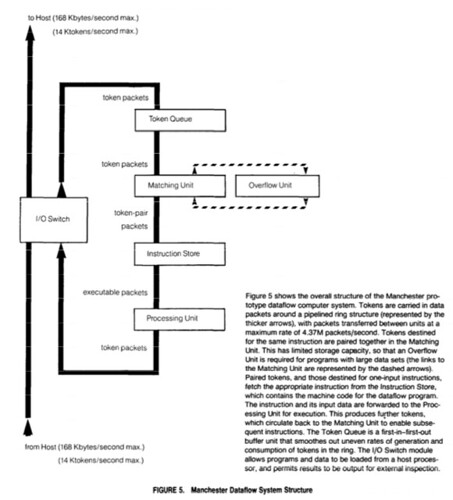
The Manchester Dataflow Machine: obscure historical computer architecture of the month


Milind has flagged up some nearby students at Bristol Uni attempting to reimplement the Transputer. I should look at that some time. For now, some little paper I was reading last week while frittering away an unexpected few days in a local hospital.

The Manchester Dataflow Machine


The MDM was some mid-1980s exploration of a post-microprocessor architecture, the same era as RISC, the Transputer and others. It was built from 74F-series logic, TTL rather than CMOS; performance numbers aren't particularly compelling by today's standard. What matters more is its architectural model.

In a classic von-Neumann CPU design, there's a shared memory for data and code; the program counter tells the CPU where to fetch the next instruction from. It's read, translated into an operation and then executed. Ops can work with memory, registers exist as an intermediate stage, essentially an explicit optimisation to deal with memory latency, branching implemented by changing the PC. The order of execution of operations is defined by the order of machine code instructions (for anyone about to disagree with me there: wait; we are talking pure von-Neumann here). It's a nice simple conceptual model, but has some flaws. A key one is that some operations take a long time (memory reads if there a cache misses, some arithmetic operations (example: division). The CPU waits, "stalls" until the operation completes, even if there is a pipeline capable of executing different stages of more than one operation at a time.

What the MDM did was accept the inevitability of those delays -and then try to eliminate them by saying "there is no program counter, there are only data dependencies".

Instead of an explicitly ordered sequence of instructions, your code lists operations a unset or binary operations against the output of previous actions and/or fetches from memory. The CPU then executes those operations in a order which guarantees those dependencies are met, but where the exact order is chosen based on the explicit dependency graph, not the implicit one of the sequence of opcodes produced by the compiler/developer.

Implementation-wise, they had a pool of functional units, capable of doing different operations, wired up by something which would get the set of instructions from (somewhere), stick them in the set of potential operations, and as slots freed up in the functional units, dispatch operations which were ready. Those operations generated results, which would make downstream operations ready for dispatch.

The Manchester Dataflow Machine Architecture

This design offered parallel execution proportional to the number of functional units: add more adders, shifters, dividers and they could be kept busy. Memory IO? Again, a functional unit could handle a read or a write, though supporting multiple units may be trickier. Otherwise, the big limitation on performance comes in conditional branching: you can't schedule any work until you know it's conditions are met. Condition evaluation, then, becomes a function of its own, with all code that comes after dependent on the specific outcomes of the condition.

To make this all usable, a dataflow language was needed; the one the paper talks about is SISAL. This looks like a functional language, one designed to compile down to the opcodes a dataflow machine needs.

Did it work? yes. Did it get adopted? No. Classic procedural CPUs with classic procedural HLLs compiling down to assembly language where the PC formed an implicit state variable is what won out. It's how we code and what we code for.

And yet, what are we coding: dataflow frameworks and applications at the scale of the datacentre. What are MapReduce jobs but a two step dataflow? What is Pig but a dataflow language? Or Cascading? What are the query plans generated by SQL engines but different data flow graphs?

And if you look at Dryad and Tez, you've got a cluster-wide dataflow engine.

At the Petascale, then, we are working in the Dataflow Space.

What we aren't doing is working in that model in the implementation languages. Here we write procedural code that is either converted to JVM bytecodes (for an abstract register machine), or compiled straight down to assembly language? And those JVM bytecodes: down to machine code at runtime. What those compilers can do is reorder the generated opcodes based on the dataflow dependency graph which it has inferred from the source. That is, even though we went and wrote procedurally, the compilers reversed the data dependencies, and generated a sequence of operations which it felt were more optimal, based on its knowledge of and assumptions about the target CPU and the cache/memory architecture within which it resides.

And this is the fun bit, which explains why the MDM paper deserves reading: the Intel P6 CPU of the late 1990s —as are all its successors- right at the heart, built around a dataflow model. They take those x86 opcodes in the order lovingly crafted by the compiler or hard-core x86 assembler coder and go "you meant well, but due to things like memory read delays, let us choose a more optimal ordering for your routines". Admittedly, they don't use the MDM architecture, instead they use Tomasulo's algorithm from the IBM 360 mainframes

A key feature there is "reservation stations", essentially register aliasing, addressing the issue that Intel parts have a limited and inconsistent set of registers. If one series of operations work on registers eax and ebx and a follow-on sequence overwrites those registers, the second set gets a virtual set of registers to play with. Hence, it doesn't matter if operations reuse a register, the execution order is really that of the data availability. The other big trick: speculative execution.

The P6 and successor parts will perform operations past a branch, provided the results of the operations can fit into (aliased) registers, and not anything with externally visible effects (writes, port IO, ...). The CPU tags these operations as speculative, and only realises them when the outcome of the branch is known. This means you could have a number of speculated operations, such as a read and a shift on that data, with the final output being visible once the branch is known to be taken. Predict the branch correctly and all pending operations can be realised,; any effects made visible. To maintain the illusion of sequential non-speculative operation, all operations with destinations that can't be aliased away have to be blocked until the branch result is known. For some extra fun, any failures of those speculated operations can only be raised when the branch outcome is known. Furthermore, it has to be the first failing instruction in the linear, PC-defined sequence that must visibly fail first, even if an operation actually executed ahead of it had failed. That's a bit of complexity that gets glossed over when the phrase "out of order execution" is mentioned. More accurate would be "speculative data-flow driven execution with register aliasing and delayed fault realisation".

Now, for all that to work properly, that data flow has to be valid: dependencies have to be explicit. Which isn't at all obvious once you have more than one thread manipulating shared data, more than one CPU executing operations in orders driven by its local view of the data dependencies.

Initial state
int p=0;
int ready = 0;
int outcome=100;
int val = 0;

Thread 1
p = &outcome;
ready = 1;

Thread 2
if (ready) val = *p;

Neither thread knows of the implicit dependency of p only being guaranteed to be valid after 'ready' is set. if the deference val = *p  is speculatively executed before the condition if (ready)is evaluated, then instead of ready==true implying val == 100, you could now have a stack traces from attempting to read the value at address 0. This will of course be an
obscure and intermittent bug which will only surface in the field in many-core systems, and never under the debugger.

The key point is: even if the compiler or assembly code orders things to meet your expectations, the CPU can make its own decisions. 

The only way to make your expectations clear is by getting the generated machine code to contain flags to indicate the happens-before requirements, which, when you think about it, is simply adding another explicit dependency in the data flow, a must-happen-before operator in the directed graph. There isn't an explicit opcode for that, barrier opcode goes in which tell the CPU to ensure that all operations listed in the machine code before that op will complete before the barrier. Equally importantly, that nothing will be reordered or speculatively executed ahead of it: all successor operations will then happen after. That is, the op code becomes a dependency on all predecessor operations, all that come after have the must-come-after dependency on this barrier. In x86, any operation with the LOCK attribute is a barrier, as are others (like RDTSCP). And in Java, the volatile keyword is mapped to a locked read or write, so is implicitly a barrier. No operations will be promoted ahead of the a volatile R/W, either by Javac, or by the CPU, nor will any be delayed. This means volatile operations can be very expensive, as if you have a series of them, even if there is no explicit data-dependency, they will be executed in-order. It also means that at compile-time, javac will not move operations on volatile fields out of a loop, even if there's no apparent update to them.

Given these details on CPU internals, it should be clear that we now have dataflow at the peta-scale, and at the micro-scale, where what appear to be sequential operations have their data dependencies used to reorder things for faster execution. It's only the bits in the middle that are procedural. Which is kind of ironic really: why can't it be dataflow all the way down? Well the MDM offered that, but nobody took up the offering.

Does it matter? Maybe not. Except that if you look at Intel's recent CPU work, it's adding new modules on the die for specific operations. First CRC, then AES encryption -and the new erasure coding in HDFS work is using some other native operations. By their very nature, these modules are intended to implement in Si algorithms which take many cycles to process per memory access. Which means they are inherently significantly slower than existing functional units in the CPU. Unless the hardware implementations are as fast as operations like floating point division, code that depends on the new operations' results are going to be held up for a while. Because all that OOO dataflow work is hidden, there's no way in the x86 code to send that work off asynchronously.

It'd be interesting to consider whether it would be better to actually have some dataflow view of those slow operations, something like Java's futures, where slow operations are fired off asynchronously, with a follow-up operation to block until the result of the operation is ready -with any failures being raised as this point. Do that and you start to give the coders and compiler writers visibility into where big delays can surface, and the ability to deal with them, or at least optimise around them.

Of course, you do need to make that stuff visible in the language too

Presumably someone has done work like that; I'm just not current enough with my reading.


Further Reading
[1] How Java is having its memory model tightened
[2] How C++ is giving you more options to do advanced memory get/set

2013-11-20

Television Viewing & the Deanonymization of Large Sparse Datasets.


[preamble: this is not me writing against collecting data analysing user behaviour, including Tv viewing actions. I cherish the fact that Netflix recommends different things to different family members, and I'm happy for the iPlayer team to get some generic use data and recognise that nobody actually wants to watch Graham Norton purely from the way that all viewers stop watching before the introductory credits are over. What is important here is that I get things in exchange: suggestions, content. What appears to be going on here is that a device I bought is sending details on TV watching activity so as to better place adverts on a a bit of the screen I paid for, possibly in future even interstitially during the startup of a service like Netflix or iPlayer. I don't appear to have got anything in exchange, and nobody asked me if I wanted the adverts let alone the collection of the details of myself and my family, including an 11 year old child.]

Graham Norton on iPlayer


Just after Christmas I wandered down to Richer Sounds and bought a new TV, first one in a decade, probably second TV we've owned since the late 1980s. My goal was a large monitor with support for free to air DTV and HD DTV, along with the HDMI and RGB ports to plug in useful things, including a (new) PS3 which would run iPlayer and Netflix. I ended up getting a deeply discounted LG Smart TV as the "smart" bits came with the monitor that I wanted.

I covered the experience back in March, where I stated that I felt that smart bit was AOL-like in its collection of icons of things I didn't want and couldn't delete, it's dumbed down versions of Netflix and iPlayer, and its unwanted adverts in the corner. But that's it, the netflix tablet/TV integration compensates for the weak TV interface, and avoids the problem of PS3 access time limits on school nights, as the PS3 can stay hidden until weekends.

Untitled

Last week I finally acceded to the TV's "new update available" popups, after which came the "reboot your TV" message. Which I did, to then get told that I had to accept an updated privacy policy. I started to look at this, but after screen 4 of 20+ gave up, mentioning it briefly on that social networking stuff (who give me things like Elephant-Bird in exchange for their logging my volunteered access -access where I turn off location notification in all devices).

I did later regret not capturing that entire privacy policy by camera, and tried to see if I could find it on line, but at the time, the search term "LG SmartTV privacy policy" returned next to nothing apart from a really good policy for the LG UK web site, which even goes into the detail of identifying each cookie and its role. I couldn't see the policy after a quick perusal of the TV menus, so that was it.

Only a few days later, Libby Miller pointed me at an article by DoctorBeet, who'd spun wireshark up to listen to what the TV was saying, and so showing how his LG TV is doing an HTTP forms  POST to a remote site of every channel change, as well as details on filenames in USB sticks.

This is a pretty serious change on what a normal television does. DoctorBeet went further and looked at why. Primarily it appears to be for advert placement, including in that corner of the "smart" portal, or a start time after you select "premium" content like iPlayer or netflix. I haven't seen that which is good -an extra 1.5MB download for an advert I'd have to stare through is not something I'd have been happy with.

Anyway, go look at his article, or even a captured request.

I'm thinking of setting up wireshark to do the same for an evening. I made an attempt yesterday but as the TV is CAT-5 to a 1Gbs hub, then an ether over power bridge to get into the base station, it's harder than I'd thought. My entire wired network is on switched ports so I can't packet sniff, and the 100 MB/s hub I dredged up from the loft turned out to be switched too. That means I'd have to do something innovative like use the WEP-only 802.11b ether to wifi bridge I also found in that box, hooked up to an open wifi base station plugged into the real router. Maybe at the weekend. A couple of days logs would actually be an interesting dataset even if it just logs PS3 activity hours as time-on-HDMI-port-1

What I did do is go to the "opt out of adverts" settings page DoctorBeet had found, scrolled down and eventually followed some legal info link to get back to the privacy settings. Which I did photo this time, and which are now up on Flickr.

Some key points of this policy

Information considered to be non personally identifiable include MAC addresses and "information about the live content you are watching"


LG Smart TV Privacy Policy


That's an interesting concept, which I will get back to. for now. note that that specific phrase is not indexed anywhere into BigTable, implying it is not published anywhere that google can index it.
Phrase not found: "information about the live content you are watching"

Or "until you sit through every page with a camera this policy doesn't get out much"

If you have issues, don't use the television

LG Smart TV Privacy Policy

That's at least consistent with customer support.

Anyway. there's a lot more slides. One of them gives a contact, who when  you tap in to LinkedIn not only shows that he's the head of legal at LGE UK,  that he's one hop away from me: datamining in action.

Now, returning to a key point: Is TV channel data Non-personal information?

Alternatively: If I had the TV viewing data of a large proportion of a country, how would I deanonymize it?

The answer there is straightforward, I'd use the work of [2004 Arvind Narayanan and Vitaly Shmatikov], Robust De-anonymization of Large Sparse Datasets.

In that seminal paper, Narayanan and Shmatikov took the anonymized Netflix dataset of (viewers->(movies, rankings)+), and deanonymized it by comparing film reviews on Netflix with IMDb reviews, looking for reviews that appeared on IMDb shortly after a Netflix review with ratings matching/close to that a Netflix review. They then took the sequence of a viewers' watched movies and looked to see if a large set of their Netflix review met that match critera. At the end of which they managed to deanonymize some Netflix viewers -correlating them with an IMDb reviewer may standard deviations out from from any other candidate. They could then use this  match to identify those movies which the viewer had seen and yet not reviewed on IMDb.

The authors had some advantages, both netflix and IMDb had reviews, albeit on a different scale. the TV details don't so the process would be more ad-hoc

  1. Discard all events that aren't movies
  2. Assume that anything where the user comes in late to some threshold isn't a significant "watch event" and discard.
  3. Assume that anything where the user watches all the way to the end is a significant "watch event" and may be reviewed later.
  4. Assume that watching events where the viewer changes channel some distance into a movie -say 20 min- as a significant watch failure event, which may be reviewed negatively.
  5. Consider watch events where the user was on the same channel for some time before the movie began as less significant than when they tuned in early.
  6. If information is collected when a user explicitly records a movie, a "recording event", that is treated even more significantly.
  7. Go through the IMDb data looking for any reviews appearing a short time after a significant set of watch events, expecting higher ratings from significant watch events and recording events, and potentially low ratings from a significant watch failure.

I don't know how many matches you'd get here -as the paper shows, it's the real outliers you find, especially the watchers of obscure content.

Even so, the fact that it is would to possible to identify at least one viewer this way shows that TV watching data is personal information. And I'm confident that it can be done, based on the maths and the specific example in the Robust De-anonymization of Large Sparse Datasets paper.

Conclusion: irrespective of the cookie debate, TV watching data may be personal -so the entire dataset of individual users must be treated this way, with all the restrictions on EU use of personal data, and the rights of those of us with a television.

2011-11-13

Towards a Topology of Failure

Mt Hood Expedition

The Apache community is not just the mailing lists and the get togethers: it is the planet apache aggregate blog; this lets other committers share their thoughts -and look at yours. This makes for unexpected connections.

After I posted my comments on Availability in Globally Distributed Storage Systems, Phil Steitz posted wonderful article on the mathematics behind it. This impressed me, not least because of his ability to get TeX-grade equations into HTML. What he did do was look at the real theory behind it, and even attempted to implement Dynamic Programming solution the problem.

I'm not going to be that ambitious, but I will try and link this paper -and the other ones on server failures, into a new concept, "Failure Topology". This is an excessively pretentious phrase, but I like it -if it ever takes off I can claim I was the first person to use it, as I can do with "continuous deployment"

The key concept of Failure Topology is that failures of systems often follow topologies. Rack outages can be caused by rack-level upgrades. Switch-level outages can take out 1* racks and are are driven by the network topology. Power outages can be caused by the failure of power supplies to specific servers, sets of servers, specific racks or even quadrants of a datacentre. There's the also the notion of specific hardware instances, such as server batches with the same run of HDDs or CPU revisions.

Failure topologies, then, are maps of the computing infrastructure that show how these things are related, and where the risk lies. A power topology would be a map of the power input to the datacentre. We have the switch topology for Hadoop, but it is optimised for network efficiency, rather than looking at the risk of switch failure. A failure-aware topology would need to know which racks were protected by duplicate ToR switches and view them as less at risk then single-switch racks. Across multiple sites you'd need to look at the regional power grids, the different telcos. Then is the politics overlay: what government controls the datacentre sites; whether or not that government is part of the EU and hence has data protection rights, or whether there's some DMCA-style takedown rules.

You'd also need to look at physical issues: fault lines, whether the sites were downwind of Mt St Helen's class volcanoes. That goes from abstract topologies to physical maps.

What does all this mean? Well, in Disk-Locality in Datacenter Computing Considered Irrelevant, Ganesha Ananthanarayanan argues that as switch and backplane bandwidth increases you don't have to worry about where your code runs relative to the data. I concur: with 10GbE and emerging backplanes, network bandwidth means that switch-local vs switch-remote will become less important. Which means you can stop worrying about Hadoop topology scripts driving code execution policies. Doing this now opens a new possibility:

Writing a script to model the failure topology of the datacentre.

You want to move from a simple "/switch2/node21" map to one that includes power sources, switches, racks, shared-PSUs in servers, something like "/ups1/switch2/rack3/psu2/node21". This models not the network hierarchy, but the failure topology of the site. Admittedly, it assumes that switches and racks share the same UPS, but if the switch power source goes away, the rack is partitioned and effectively offline anyway -so you may as well do that.

I haven't played with this yet, but as I progress with my patch to allow Hadoop to focus on keeping all blocks on separate racks for availability, this failure topology notion could be the longer term topology that the ops team need to define.

[Photo: sunrise from the snowhole on the (dormant) volcano Mt Hood -not far from Google's Dalles datacentre]