Showing posts with label datamining. Show all posts

2018-01-29

Advanced Deanonymization through Strava

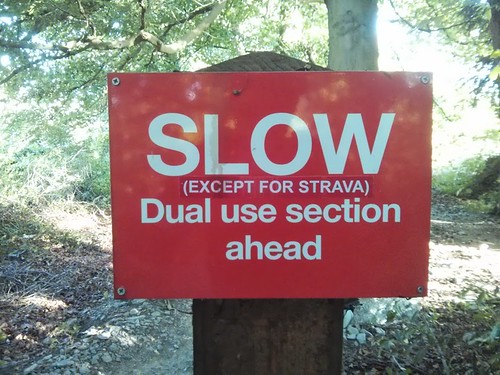
Slow Except for Strava

Strava is getting some bad press, because its heatmap can be used to infer the existence and floorplan of various US/UK military and govt sites.

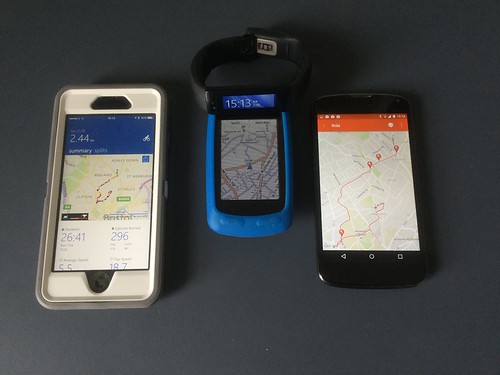
I covered this briefly in my Berlin Buzzwords 2016 Household INFOSEC talk , though not into that much detail about what's leaked, what a Garmin GPS tracker is vulnerable to (Not: classic XML entity/XInclude attacks, but a malicious site could serve up a subverted GPS map that told me the local motorway was safe to cycle on).
Untitled

Here are some things Strava may reveal

  • Whether you run, swim, ski or cycle.
  • If you tell it, what bicycles you have.
  • Who you go out on a run or ride with
  • When you are away from your house
  • Where you commute to, and when
  • Your fitness, and whether it is getting better or worse.
  • When you travel, what TZ, etc.

How to lock down your account?

I only try to defend against drive-by attacks, not nation states or indeed, anyone competent who knows who I am. For Strava then, my goal is: do not share information about where my bicycles are kept, nor those of my friends. I also like to not share too much about the bikes themselves. This all comes secondary to making sure that nobody follows me back from a ride over the Clifton Suspension Bridge (standard attack: wait at the suspension bridge, cycle after them. Standard defence: go through the clifton backroads, see if you are being followed). And I try to make sure all our bikes are locked up, doors locked etc. The last time one got stolen was due to a process failure there (unlocked door) and so the defences fell to some random drug addict rather than anyone using Strava. There's a moral there, but it's still good to lock down your data against tomorrow's Strava attacks, not just today's. My goal: keep my data secure enough to be safe from myself.
  1. I don't use my real name. You can use a single letter as a surname, an "!", or an emoji.
  2. And I've made sure that none of the people I ride regularly do so either
  3. I have a private area around my house, and those of friends.
  4. All my bikes have boring names "The Commuter", not something declaring value.
  5. I have managed fairly successfully to stay of the KoM charts, apart from this climb which I regret doing on so many levels.
For a long time I didn't actually turn the bike computer on until I'd got to the end of the road. I've got complacent there. Even though Strava strips the traces from the private zone when publishing, it does appear to declare the ride distance as the full distance. Given enough rides of mine, you can infer the radius of that privacy zone (fix? Have two overlapping circles?), and the distance on road from the cutoff points to where my house is (overlapping circles won't fix that). You'd need to strip out the start/stop points before uploading to strava (hard) or go back to only switching on recording once you were a randomish distance from your setoff point.

I haven't opted out of the Strava Heatmap, as I don't go anywhere that people care about. That said, there's always concerns in our local MTB groups that Strava leaks the non-official trails to those people who view stopping MTB riders as their duty. A source of controversy.

Now, how would I go for someone else's strava secrets?

You can assume that anyone who scores high in a mountain bike trail is going to have an MTB worth stealing, same for long road climbs.
  1. Ride IDs appear sequential, so you could harvest a days' worth and search.
  2. Join the same cycling club as my targets, see if they publish rides. Fixes: don't join open clubs, ever, and verify members of closed clubs.
  3. Strava KoM chart leakage. Even if you make your rides private, if you get on top 10 riders for that day or whatever, you become visible.
The fact that you can infer nation-state secrets is an interesting escalation. Currently it's the heatmap which is getting the bad press, which is part of the dataset that Strava offer commercially to councils. FWIW, the selection bias on Strava data (male roadies or mountain bikers) means that its not that good. If someone bought our local data, they'd infer that muddy wood trails with trees and rocks are what the city needs. Which is true, but it doesn't address the lack of any safe way to cross the city.

What is interesting about the heat map, and not picked up on yet, is that you can potentially deanonymize people from it.

First, find somewhere sensitive, like say, The UK Faslane Nuclear Submarine Base. Observe the hot areas, like how people run in rectangles in the middle.
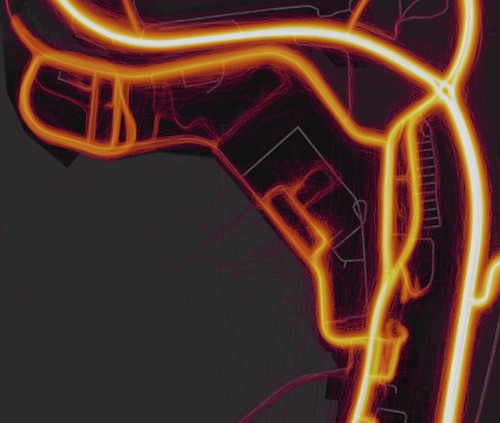
Faslane Heat Map
Now, go to MapMyRide and log in. Then head over to create a new route using the satellite data
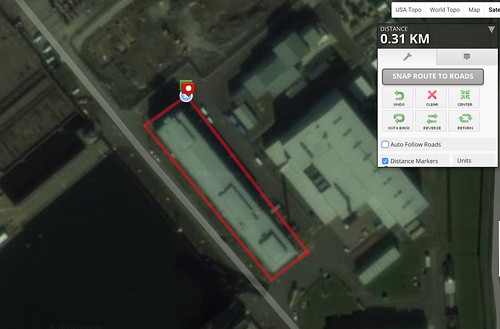
Created Route from the hotspot map

Download the GPX file. This contains the Lat/Long values of the route

If you try to upload it to strava, it'll reject it as there's no timing data. So add it, using some from any real GPX trace as a reference point. Doesn't have to be valid time, just make it slow enough that Strava doesn't think you are driving and tell you off for cheating.

Upload the file as a run, creating a new activity
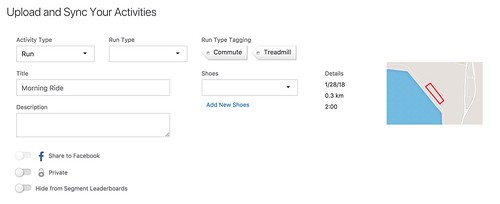
Faked run uploaded

The next step is the devious one. "Create a segment", and turn part/all of the route into a Strava segment.
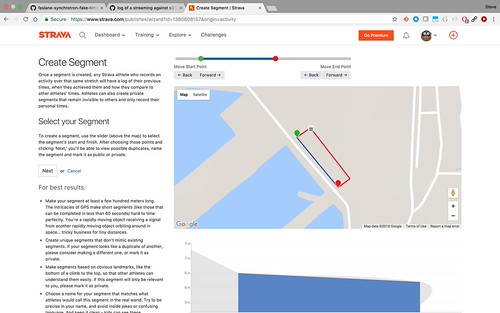
Creating a segment from the trace


Once strava has gone through its records, you'll be able to see the overall top 10  runners per gender/age group, when they ran, it who they ran with. And, if their profile isn't locked down enough: which other military bases they've been for runs on.
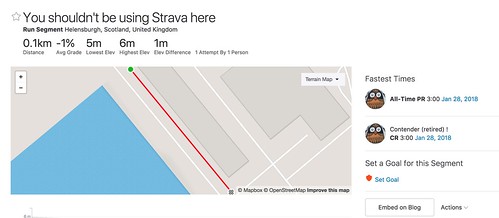
And now we wait to see who else did it


I have no idea who has done this run; whether there'll be any segment matches at all. If not, maybe the trace isn't close enough to the real world traces, everyone runs round clockwise, or, hopefully, people are smart enough to mark the area as a private. I'll leave strava up overnight to see what it shows, then delete the segment and run.

Finally, Berlin Buzzwords CFP is open, still offering to help with draft proposals. We can now say it's the place where Strava-based infosec issues were covered 2 years before it was more widely known.

Update 2018-01-29T21:13. I've removed the segment.
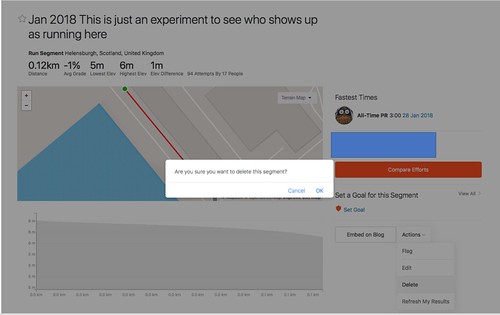
Removing Segment
Some people's names were appearing there, showing that, yes, you can bootstrap from a heatmap to identification of individual people who have run the same route.
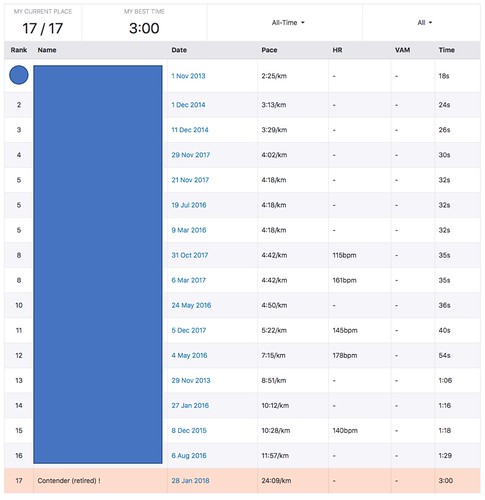
Segment top 17, as discovered
There's no need to blame the people here, so I've pulled the segment to preserve their anonymity. But as anyone else can do it, they should still mark all govt. locations where they train as private areas, so getting included from the heatmap and strava segments.

I don't know what Strava will do long term, but to stop it reoccurring, they'll need to have a way to mark an area as "private area for all users". Doable. Then go to various governments and say "Give us a list of secret sites you don't want us to cover". Which, unless the governments include random areas like mountain ranges in mid wales, is an interesting list of its own.

Update 2018-01-30T16:01 to clarify on marking routes private

  1. All ride/runs marked as "private" don't appear in the leader boards
  2. All ride/runs marked as "don't show in leader boards" don't appear
  3. Nor do any activities in a privacy zone make it onto a segment which starts/ends there
  4. But: "enhanced privacy mode" activities do. That is: even you can't see an individuals's activities off their profile, you can see the rides off the leaderboard.
Update 2018-01-31T00:30 Hacker News coverage

I have made Hacker news. Achievement Unlocked!

Apparently
This is neither advanced nor denanonymization (sic).
They basically pluck an interesting route from the hotmap (as per other people's recent discovery), pretend that they have also run/biked this route and Strava will show them names of others who run/biked the same way. That's clever, but that's not "advanced" by any means.
It's also not a deanonymization as there's really no option in Strava for public _anonymous_ sharing to begin with.

1. Thanks for pointing out the typo. Fixed.

2. It's bootstrapping from nominally anon heatmap data to identifying the participants of the route. And unless people use nicknames (only 2 of the 16 in the segment above) did, then you reveal your real name. And as it shows the entire route when you click through the timestamp, you get to see where they started/finished, who if anyone they went with, etc, etc. You may not their real name, but you know a lot about them.

3. "It''s not advanced". Actually, what Strava do behind the scenes is pretty advanced :). They determine which of all recorded routes they match that segment, within 24h. Presumably they have a record of the bounds of every ride, so first select all rides whose bounds completely enclose the segment. Then they have to go through all of them to see if there is a fraction of their trail which matches.. I presume you'd go with the start co-ord and scan the trace to see if any of the waypoints *or inferred bits of the line between two recorded waypoints* is in the range of that start marker. If so, carry on along the trace looking for the next waypoint of the segment; giving up if the distance travelled is >> greater than the expected distance. And they do that for all recorded events in past history. 

All I did was play around with a web UI showing photographs from orbiting cameras, adjacent to a map of the world with humanities' activities inferred by published traces of how phones, watches and bike computers calculated their positions from a set of atomic clocks, uploaded over the internet to a queue in Apache Kafka, processed for storage in AWS S3, whose consistency and throttling is the bane of my life and rendered via Apache Kafka, as covered in Strava Engineering. That is impressive work. Some of their analysis code is probably running through lines of code which I authored, and I'm glad to have contributed to something which is so useful, and, for the heatmap, beautiful to look at. 

So no, I wasn't the one doing the advanced engineering —but I respect those who did, and pleased to see the work of people I know being used in the app.

2015-11-06

Prime numbers —you know they make sense


The UK government has just published its new internet monitoring bill.

Sepr's Mural and the police

Apparently one of the great concessions is they aren't going to outlaw any encryption they can't automatically decrypt. This is not a concession: someone has sat down with them and explained how RSA and elliptic curve crypto work, and said "unless you have a ban on prime numbers > 256 bits, banning encryption is meaningless". What makes the government think they have any control over what at-rest encryption code gets built into phone operating systems or between mobile apps written in California. They didn't have a chance of making this work; all they'd do is be laughed at from abroad while crippling UK developers. As an example, if releasing software with strong encryption were illegal, I'd be unable to make releases of Hadoop —simply due to HDFS encryption.

You may as well assume that nation states already do have the abilities to read encrypted messages (somehow), and deal with that by "not becoming an individual threat to a nation state". Same goes for logging of HTTP/S requests. If someone really wanted to, they could. Except that until now the technical abilities of various countries had to be kept a secret, because once some fact about breaking RC4 or DH forward encryption becomes known, software changes.

What is this communications bill trying to do then? Not so much legalise what's possible today, but give the local police forces access to similar datasets for everyday use. That's probably an unexpected side-effect of the Snowden revelations: police forces round the country saying "ooh, we'd like to know that information", and this time demanding access to it in a way that they can be open about in court.

As it stands, it's mostly moot. Google knows where you were, what your search terms were and have all your emails, not just the metadata. My TV vendor claims the right to log what I watched on TV and ship it abroad, with no respect for safe-harbour legislation. As for our new car, it's got a modem built in and if it wants to report home not just where we've been driving but whether the suspension has been stressed, ABS and stability control engaged, or even what radio channel we were on, I would have no idea whatsoever. The fact that you have to start worrying about the INFOSEC policies of your car manufacturer shows that knowing which web sites you viewed is becoming less and less relevant.

Even so, the plan to record 12 months of every IP address's HTTP(S) requests, (and presumably other TCP connections) is a big step change, and not one I'm happy about. It's not that I have any specific need to hide from the state —and if I did, I'd try tunnelling through DNS, using Tor, VPNing abroad, or some other mechanism. VPNs are how you uprate any mobile application to be private —and as they work over mobile networks, deliver privacy on the move. I'm sure I could ask a US friend to set up a raspberry pi with PPTP in their home, just as we do for BBC iPlayer access abroad. And therein lies a flaw: if you really want to identify significant threats to the state and its citizens, you don't go on about how you are logging all TCP connections, as that just motivates people to go for VPNs. So we move the people that are most dangerous underground, while creating a dataset more of interest to the MPAA than anyone else.

[Photo: police out on Stokes Croft or Royal Wedding Day after the "Second Tesco Riot"]

2013-11-20

Television Viewing & the Deanonymization of Large Sparse Datasets.


[preamble: this is not me writing against collecting data analysing user behaviour, including Tv viewing actions. I cherish the fact that Netflix recommends different things to different family members, and I'm happy for the iPlayer team to get some generic use data and recognise that nobody actually wants to watch Graham Norton purely from the way that all viewers stop watching before the introductory credits are over. What is important here is that I get things in exchange: suggestions, content. What appears to be going on here is that a device I bought is sending details on TV watching activity so as to better place adverts on a a bit of the screen I paid for, possibly in future even interstitially during the startup of a service like Netflix or iPlayer. I don't appear to have got anything in exchange, and nobody asked me if I wanted the adverts let alone the collection of the details of myself and my family, including an 11 year old child.]

Graham Norton on iPlayer


Just after Christmas I wandered down to Richer Sounds and bought a new TV, first one in a decade, probably second TV we've owned since the late 1980s. My goal was a large monitor with support for free to air DTV and HD DTV, along with the HDMI and RGB ports to plug in useful things, including a (new) PS3 which would run iPlayer and Netflix. I ended up getting a deeply discounted LG Smart TV as the "smart" bits came with the monitor that I wanted.

I covered the experience back in March, where I stated that I felt that smart bit was AOL-like in its collection of icons of things I didn't want and couldn't delete, it's dumbed down versions of Netflix and iPlayer, and its unwanted adverts in the corner. But that's it, the netflix tablet/TV integration compensates for the weak TV interface, and avoids the problem of PS3 access time limits on school nights, as the PS3 can stay hidden until weekends.

Untitled

Last week I finally acceded to the TV's "new update available" popups, after which came the "reboot your TV" message. Which I did, to then get told that I had to accept an updated privacy policy. I started to look at this, but after screen 4 of 20+ gave up, mentioning it briefly on that social networking stuff (who give me things like Elephant-Bird in exchange for their logging my volunteered access -access where I turn off location notification in all devices).

I did later regret not capturing that entire privacy policy by camera, and tried to see if I could find it on line, but at the time, the search term "LG SmartTV privacy policy" returned next to nothing apart from a really good policy for the LG UK web site, which even goes into the detail of identifying each cookie and its role. I couldn't see the policy after a quick perusal of the TV menus, so that was it.

Only a few days later, Libby Miller pointed me at an article by DoctorBeet, who'd spun wireshark up to listen to what the TV was saying, and so showing how his LG TV is doing an HTTP forms  POST to a remote site of every channel change, as well as details on filenames in USB sticks.

This is a pretty serious change on what a normal television does. DoctorBeet went further and looked at why. Primarily it appears to be for advert placement, including in that corner of the "smart" portal, or a start time after you select "premium" content like iPlayer or netflix. I haven't seen that which is good -an extra 1.5MB download for an advert I'd have to stare through is not something I'd have been happy with.

Anyway, go look at his article, or even a captured request.

I'm thinking of setting up wireshark to do the same for an evening. I made an attempt yesterday but as the TV is CAT-5 to a 1Gbs hub, then an ether over power bridge to get into the base station, it's harder than I'd thought. My entire wired network is on switched ports so I can't packet sniff, and the 100 MB/s hub I dredged up from the loft turned out to be switched too. That means I'd have to do something innovative like use the WEP-only 802.11b ether to wifi bridge I also found in that box, hooked up to an open wifi base station plugged into the real router. Maybe at the weekend. A couple of days logs would actually be an interesting dataset even if it just logs PS3 activity hours as time-on-HDMI-port-1

What I did do is go to the "opt out of adverts" settings page DoctorBeet had found, scrolled down and eventually followed some legal info link to get back to the privacy settings. Which I did photo this time, and which are now up on Flickr.

Some key points of this policy

Information considered to be non personally identifiable include MAC addresses and "information about the live content you are watching"


LG Smart TV Privacy Policy


That's an interesting concept, which I will get back to. for now. note that that specific phrase is not indexed anywhere into BigTable, implying it is not published anywhere that google can index it.
Phrase not found: "information about the live content you are watching"

Or "until you sit through every page with a camera this policy doesn't get out much"

If you have issues, don't use the television

LG Smart TV Privacy Policy

That's at least consistent with customer support.

Anyway. there's a lot more slides. One of them gives a contact, who when  you tap in to LinkedIn not only shows that he's the head of legal at LGE UK,  that he's one hop away from me: datamining in action.

Now, returning to a key point: Is TV channel data Non-personal information?

Alternatively: If I had the TV viewing data of a large proportion of a country, how would I deanonymize it?

The answer there is straightforward, I'd use the work of [2004 Arvind Narayanan and Vitaly Shmatikov], Robust De-anonymization of Large Sparse Datasets.

In that seminal paper, Narayanan and Shmatikov took the anonymized Netflix dataset of (viewers->(movies, rankings)+), and deanonymized it by comparing film reviews on Netflix with IMDb reviews, looking for reviews that appeared on IMDb shortly after a Netflix review with ratings matching/close to that a Netflix review. They then took the sequence of a viewers' watched movies and looked to see if a large set of their Netflix review met that match critera. At the end of which they managed to deanonymize some Netflix viewers -correlating them with an IMDb reviewer may standard deviations out from from any other candidate. They could then use this  match to identify those movies which the viewer had seen and yet not reviewed on IMDb.

The authors had some advantages, both netflix and IMDb had reviews, albeit on a different scale. the TV details don't so the process would be more ad-hoc

  1. Discard all events that aren't movies
  2. Assume that anything where the user comes in late to some threshold isn't a significant "watch event" and discard.
  3. Assume that anything where the user watches all the way to the end is a significant "watch event" and may be reviewed later.
  4. Assume that watching events where the viewer changes channel some distance into a movie -say 20 min- as a significant watch failure event, which may be reviewed negatively.
  5. Consider watch events where the user was on the same channel for some time before the movie began as less significant than when they tuned in early.
  6. If information is collected when a user explicitly records a movie, a "recording event", that is treated even more significantly.
  7. Go through the IMDb data looking for any reviews appearing a short time after a significant set of watch events, expecting higher ratings from significant watch events and recording events, and potentially low ratings from a significant watch failure.

I don't know how many matches you'd get here -as the paper shows, it's the real outliers you find, especially the watchers of obscure content.

Even so, the fact that it is would to possible to identify at least one viewer this way shows that TV watching data is personal information. And I'm confident that it can be done, based on the maths and the specific example in the Robust De-anonymization of Large Sparse Datasets paper.

Conclusion: irrespective of the cookie debate, TV watching data may be personal -so the entire dataset of individual users must be treated this way, with all the restrictions on EU use of personal data, and the rights of those of us with a television.