Showing posts with label mathematics. Show all posts

2016-02-27

Voxxdev Bristol 2016: theory meets practitioners

I've been hanging out with other bits of the Bristol tech/dev world recently, rather than the usual big data suspects.

Two weeks ago, I actually infiltrated the local Test meetup, which was entertaining, not just for the Bath Gem Ale which JustEat has on tap in their meeting area, but because I sit there, beer in hand, while speakers covered Applied Exploratory Testing, what its like turning up as a QA team to a new company and the patterns-of-untestability that you encounter (and how to start to get things under control).

This week, I took a break from worrying about the semantics of flush() and its impact of durability of timeline 1.5 event histories. (i.e. why my incomplete apps aren't showing up in an ATS-backed  Spark History server if file:// is the intermediate FS of the test run). Wandered down to the Watershed Cinema with Tom White and a light hangover related to Tom White's overnight stay including an evening visit the Bravas Tapas Bar —and into a one-day dev conference, Voxxdev Bristol 2016.

It was a good day. Oracle have been putting a lot of effort into the conf as a way raising visibility of what's going on in tech in the area to make more people aware the west of england a more interesting place to be than London, and with other companies and one of the local universities had put together a day-long conference.

I was one of the speakers; I'd put in my Household Infosec talk, but the organisers wanted something more code-related, and opted for Hadoop and Kerberos, the Madness Beyond The Gate. I don't think that was the right talk for the audience. It's really for people writing code to run inside a Hadoop cluster, and to explain to the QE and support people that the reason they suffer so much is those developers aren't testing on secure clusters. (that's the version I gave at Cloudera Palo Alto last month). When you are part way into a talk and you realise that you can't assume the audience knows how HDFS works then you shouldn't really be talking to them about retrieving block-tokens from the NN from a YARN app handed off a delegation token in the launch context by a client authed against the KDC. Normally I like a large fraction of the audience to come out of a talk feeling they'd benefited; this time I'm not sure.

I felt a bit let down the oracle big data talk, though impressed that people are still writing Swing apps. I was even more disappointed by the IoT talk, where he not only accused Hadoop of being insecure (speaker missed my talk, then), most of his slides seemed lifted from elsewhere: one a cisco IoT arch, one dell hadoop cluster design. Julio pointed out later that the brontobyte slide was one HP Labs have been using. Tip: if you use other's slides, either credit them or make sure the authors aren't attendees.

I really liked some of the other talks. There was a great keynote by a former colleague, Dave Cliff, now at Bristol Uni, talking about what they are up to. This is the lecture series on their cloud computing course. 
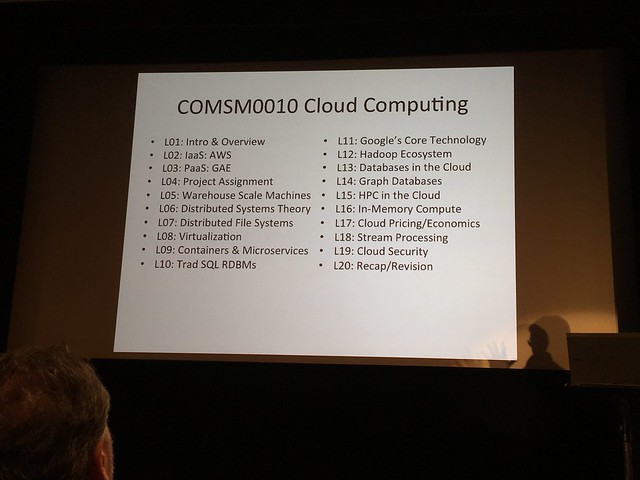
Cloud Computing Curriculum

That's a big change given that in 2010, all they had was a talk Julio and I gave in the HPC course

I might volunteer to give one of the new course's talks in exchange for being able to sit in on the other lectures (and exemption from exams, tutorials and homework, obviously)

My favourite talk turned out to be Out of the Fire Swamp, by Adrian Colyer.

Adrian writes "The morning paper" blog, which is something I'm aware of, in awe of and in fear of. Why fear? There's too many papers to read; I can't get through 1/day and to track the blog would only make it clear how behind I was. I already have a directory tree full of papers I think I need to understand. Of course, if you do read a related paper/day, it probably gets easier, except I'm still trying to complete [Ulrich99], as my and relate it to modern problems.

Adrian introduced the audience to data serialization, causality and happens-before, then into linearalizability [HW90]
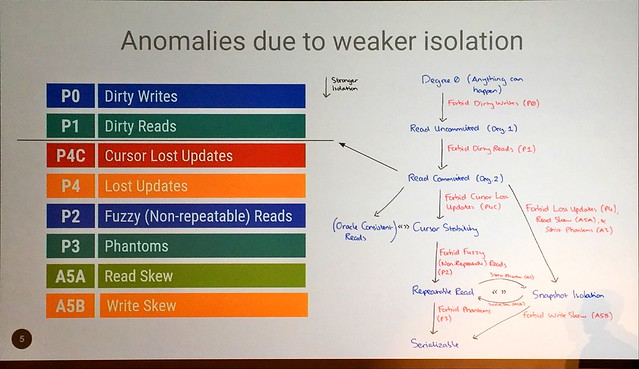
Read Committed


This was a really good talk.

Expectations and Reality

All the code we write is full of assumptions. We assume that n + 1 > n, though we know in our head that if n = 2^31 and its stored in a signed int32, that doesn't hold. (more formally, in two's complement binary arithmetic, for all registers of width w, n+1 > n only holds for all n where n < 2^(w-1).

Sometimes even that fundational n+1 > n assumption catches us out. We assume that two assignments in source code happen in order, though in fact not only does the JVM reserve the right to re-order things, even, in the past, wrongly —and anyway, the CPU can reorder stuff as well.

What people aren't aware of in modern datacentre-scale computing is what assumptions the systems underneath have made in order to give their performance/consistency/availability/liveness/persistence features or whatever it is they offer. To put differently: we think we know what the systems we depend on do, but every so often we find out our assumptions were utterly wrong. What Adrian covered is the foundational CS-complete assumptions, that you had really be asking hard questions about when you review technologies.

He also closed with a section on future system trends, especially storage, with things like  non-volatile DIMMS (some capacitor + SSD to do a snapshot backup on power loss), faster SSD and those persistent technologies with performance between DRAM and SSD: looking at a future where tomorrow's options about durability vs. retrieval time are going to be (at least from some price points), significantly different from today's. Which means that we'd better stop hard coding those assumptions into our systems.


Overall, a nice event, especially given it in the second closest place to my house where you could hold a conference (Bristol University would have been 7 minutes rather than 15 minutes walk). I had the pleasure of meeting some new people in the area working on stuff, including the illustrious James Strachan who'd come up from Somerset for the day.

I liked the blend of some CS "Lamport Layer" work with practical stuff; gives you both education and things you can make immediate use of. I know Martin Kleppman has been going round evangelising classic distributed computing problems to a broader audience, and Berlin Buzzwords 2016 has a talk Towards consensus on distributed consensus  it's clearly something the conferences need.

If there was a fault, as well as some of the talks not being ideal for the audience (mine), I'd say it's got the usual lack of diversity of a tech conference. You could say "well. that's the industry", but it doesn't have to be, and even if that is the case it doesn't have to be so unbalanced in the speakers. In the BBuzz even not only are there two women keynoting, we submission reviewers were renewing the talks anonymously: we didn't know who was submitting, instead going on the text alone.

For the next Bristol conference, I'd advocate going closer in Uni/industry collaboration by offering some of the students tickets. Maybe even some of the maths & physics students rather than just CS. I also think maybe there should be a full strand dedicated to CS theory. Seriously: we can do causality, formality, set theory & relational algebra, paxos+ZK+REEF, reliability theory, graphs etc. Things that apply to the systems we use, but stuff people kind of ignore. I like this idea ... I can even think of a couple of speakers. Me? I'd sit in the audience trying to keep up.

[HW90] Herlihy and Wing, Linearizability: A Correctness Condition for Concurrent Objects, 1990.

[Ulrich99] Ulrich, A.W., Zimmerer, P. and Chrobok-Diening, Test architectures for testing distributed system, 1999. Proceedings of the 12th International Software Quality Week.

2013-11-20

Television Viewing & the Deanonymization of Large Sparse Datasets.


[preamble: this is not me writing against collecting data analysing user behaviour, including Tv viewing actions. I cherish the fact that Netflix recommends different things to different family members, and I'm happy for the iPlayer team to get some generic use data and recognise that nobody actually wants to watch Graham Norton purely from the way that all viewers stop watching before the introductory credits are over. What is important here is that I get things in exchange: suggestions, content. What appears to be going on here is that a device I bought is sending details on TV watching activity so as to better place adverts on a a bit of the screen I paid for, possibly in future even interstitially during the startup of a service like Netflix or iPlayer. I don't appear to have got anything in exchange, and nobody asked me if I wanted the adverts let alone the collection of the details of myself and my family, including an 11 year old child.]

Graham Norton on iPlayer


Just after Christmas I wandered down to Richer Sounds and bought a new TV, first one in a decade, probably second TV we've owned since the late 1980s. My goal was a large monitor with support for free to air DTV and HD DTV, along with the HDMI and RGB ports to plug in useful things, including a (new) PS3 which would run iPlayer and Netflix. I ended up getting a deeply discounted LG Smart TV as the "smart" bits came with the monitor that I wanted.

I covered the experience back in March, where I stated that I felt that smart bit was AOL-like in its collection of icons of things I didn't want and couldn't delete, it's dumbed down versions of Netflix and iPlayer, and its unwanted adverts in the corner. But that's it, the netflix tablet/TV integration compensates for the weak TV interface, and avoids the problem of PS3 access time limits on school nights, as the PS3 can stay hidden until weekends.

Untitled

Last week I finally acceded to the TV's "new update available" popups, after which came the "reboot your TV" message. Which I did, to then get told that I had to accept an updated privacy policy. I started to look at this, but after screen 4 of 20+ gave up, mentioning it briefly on that social networking stuff (who give me things like Elephant-Bird in exchange for their logging my volunteered access -access where I turn off location notification in all devices).

I did later regret not capturing that entire privacy policy by camera, and tried to see if I could find it on line, but at the time, the search term "LG SmartTV privacy policy" returned next to nothing apart from a really good policy for the LG UK web site, which even goes into the detail of identifying each cookie and its role. I couldn't see the policy after a quick perusal of the TV menus, so that was it.

Only a few days later, Libby Miller pointed me at an article by DoctorBeet, who'd spun wireshark up to listen to what the TV was saying, and so showing how his LG TV is doing an HTTP forms  POST to a remote site of every channel change, as well as details on filenames in USB sticks.

This is a pretty serious change on what a normal television does. DoctorBeet went further and looked at why. Primarily it appears to be for advert placement, including in that corner of the "smart" portal, or a start time after you select "premium" content like iPlayer or netflix. I haven't seen that which is good -an extra 1.5MB download for an advert I'd have to stare through is not something I'd have been happy with.

Anyway, go look at his article, or even a captured request.

I'm thinking of setting up wireshark to do the same for an evening. I made an attempt yesterday but as the TV is CAT-5 to a 1Gbs hub, then an ether over power bridge to get into the base station, it's harder than I'd thought. My entire wired network is on switched ports so I can't packet sniff, and the 100 MB/s hub I dredged up from the loft turned out to be switched too. That means I'd have to do something innovative like use the WEP-only 802.11b ether to wifi bridge I also found in that box, hooked up to an open wifi base station plugged into the real router. Maybe at the weekend. A couple of days logs would actually be an interesting dataset even if it just logs PS3 activity hours as time-on-HDMI-port-1

What I did do is go to the "opt out of adverts" settings page DoctorBeet had found, scrolled down and eventually followed some legal info link to get back to the privacy settings. Which I did photo this time, and which are now up on Flickr.

Some key points of this policy

Information considered to be non personally identifiable include MAC addresses and "information about the live content you are watching"


LG Smart TV Privacy Policy


That's an interesting concept, which I will get back to. for now. note that that specific phrase is not indexed anywhere into BigTable, implying it is not published anywhere that google can index it.
Phrase not found: "information about the live content you are watching"

Or "until you sit through every page with a camera this policy doesn't get out much"

If you have issues, don't use the television

LG Smart TV Privacy Policy

That's at least consistent with customer support.

Anyway. there's a lot more slides. One of them gives a contact, who when  you tap in to LinkedIn not only shows that he's the head of legal at LGE UK,  that he's one hop away from me: datamining in action.

Now, returning to a key point: Is TV channel data Non-personal information?

Alternatively: If I had the TV viewing data of a large proportion of a country, how would I deanonymize it?

The answer there is straightforward, I'd use the work of [2004 Arvind Narayanan and Vitaly Shmatikov], Robust De-anonymization of Large Sparse Datasets.

In that seminal paper, Narayanan and Shmatikov took the anonymized Netflix dataset of (viewers->(movies, rankings)+), and deanonymized it by comparing film reviews on Netflix with IMDb reviews, looking for reviews that appeared on IMDb shortly after a Netflix review with ratings matching/close to that a Netflix review. They then took the sequence of a viewers' watched movies and looked to see if a large set of their Netflix review met that match critera. At the end of which they managed to deanonymize some Netflix viewers -correlating them with an IMDb reviewer may standard deviations out from from any other candidate. They could then use this  match to identify those movies which the viewer had seen and yet not reviewed on IMDb.

The authors had some advantages, both netflix and IMDb had reviews, albeit on a different scale. the TV details don't so the process would be more ad-hoc

  1. Discard all events that aren't movies
  2. Assume that anything where the user comes in late to some threshold isn't a significant "watch event" and discard.
  3. Assume that anything where the user watches all the way to the end is a significant "watch event" and may be reviewed later.
  4. Assume that watching events where the viewer changes channel some distance into a movie -say 20 min- as a significant watch failure event, which may be reviewed negatively.
  5. Consider watch events where the user was on the same channel for some time before the movie began as less significant than when they tuned in early.
  6. If information is collected when a user explicitly records a movie, a "recording event", that is treated even more significantly.
  7. Go through the IMDb data looking for any reviews appearing a short time after a significant set of watch events, expecting higher ratings from significant watch events and recording events, and potentially low ratings from a significant watch failure.

I don't know how many matches you'd get here -as the paper shows, it's the real outliers you find, especially the watchers of obscure content.

Even so, the fact that it is would to possible to identify at least one viewer this way shows that TV watching data is personal information. And I'm confident that it can be done, based on the maths and the specific example in the Robust De-anonymization of Large Sparse Datasets paper.

Conclusion: irrespective of the cookie debate, TV watching data may be personal -so the entire dataset of individual users must be treated this way, with all the restrictions on EU use of personal data, and the rights of those of us with a television.

2011-11-13

Towards a Topology of Failure

Mt Hood Expedition

The Apache community is not just the mailing lists and the get togethers: it is the planet apache aggregate blog; this lets other committers share their thoughts -and look at yours. This makes for unexpected connections.

After I posted my comments on Availability in Globally Distributed Storage Systems, Phil Steitz posted wonderful article on the mathematics behind it. This impressed me, not least because of his ability to get TeX-grade equations into HTML. What he did do was look at the real theory behind it, and even attempted to implement Dynamic Programming solution the problem.

I'm not going to be that ambitious, but I will try and link this paper -and the other ones on server failures, into a new concept, "Failure Topology". This is an excessively pretentious phrase, but I like it -if it ever takes off I can claim I was the first person to use it, as I can do with "continuous deployment"

The key concept of Failure Topology is that failures of systems often follow topologies. Rack outages can be caused by rack-level upgrades. Switch-level outages can take out 1* racks and are are driven by the network topology. Power outages can be caused by the failure of power supplies to specific servers, sets of servers, specific racks or even quadrants of a datacentre. There's the also the notion of specific hardware instances, such as server batches with the same run of HDDs or CPU revisions.

Failure topologies, then, are maps of the computing infrastructure that show how these things are related, and where the risk lies. A power topology would be a map of the power input to the datacentre. We have the switch topology for Hadoop, but it is optimised for network efficiency, rather than looking at the risk of switch failure. A failure-aware topology would need to know which racks were protected by duplicate ToR switches and view them as less at risk then single-switch racks. Across multiple sites you'd need to look at the regional power grids, the different telcos. Then is the politics overlay: what government controls the datacentre sites; whether or not that government is part of the EU and hence has data protection rights, or whether there's some DMCA-style takedown rules.

You'd also need to look at physical issues: fault lines, whether the sites were downwind of Mt St Helen's class volcanoes. That goes from abstract topologies to physical maps.

What does all this mean? Well, in Disk-Locality in Datacenter Computing Considered Irrelevant, Ganesha Ananthanarayanan argues that as switch and backplane bandwidth increases you don't have to worry about where your code runs relative to the data. I concur: with 10GbE and emerging backplanes, network bandwidth means that switch-local vs switch-remote will become less important. Which means you can stop worrying about Hadoop topology scripts driving code execution policies. Doing this now opens a new possibility:

Writing a script to model the failure topology of the datacentre.

You want to move from a simple "/switch2/node21" map to one that includes power sources, switches, racks, shared-PSUs in servers, something like "/ups1/switch2/rack3/psu2/node21". This models not the network hierarchy, but the failure topology of the site. Admittedly, it assumes that switches and racks share the same UPS, but if the switch power source goes away, the rack is partitioned and effectively offline anyway -so you may as well do that.

I haven't played with this yet, but as I progress with my patch to allow Hadoop to focus on keeping all blocks on separate racks for availability, this failure topology notion could be the longer term topology that the ops team need to define.

[Photo: sunrise from the snowhole on the (dormant) volcano Mt Hood -not far from Google's Dalles datacentre]