2013-02-26

Followup: where can we do interesting things at low-levels

I managed to offend Andrew Purtell of Intel in my last post, so to make up here's some issues why Hadoop benefits from his work


Jamaica Street Feb 2012

Hardware is changing, CPU arch, memory layouts, cross-core synchronization, instructions built in the CPU. For efficient code we need everything from minimal branch misprediction to things that cut down core operations -especially decompression, checksums, encryption.

That's why the amount of native code in Hadoop is only going to increase -and that's going to take more than just skill to write -it takes the work to identify the problems and bottlenecks in the first place.


Java gets in the way here. You don't know the layout of a java class in memory, so it's near impossible to design cache-efficient designs, pulling in a class on a single cache line, avoiding false sharing within a struct. Even java's volatile opcode forces in a synchronisation barrier -making it much more expensive than C/C++ volatile. It's memory manager didn't go NUMA-aware until Java7 -it's been lagging hardware, but openJDK may speed things up there. Except now there's the problem of testing Hadoop on trunk builds of openJDK.

Looking forward, the end of HDDs is inevitable, but before then, mixed SSD and HDD will be the trend -and HDFS has to use that, somehow deciding where to put data, and knowing where it is.

If you are scheduling an MR job, and you have fast 10GbE networking, then the job placement problem becomes less of "where is there a slot on any of the three server with the data" and more "which of my 3 replicas are in SSD" -then doing work on or near that server, as things will complete that much faster.

And to have some storage of replicas across tiers will need HDFS knowing about the options, and making decisions. Those decisions will be hard, and you'll need something like a rebalancer in each host, moving cold data out of the SSD, so leaving space for warm data. Unless the SSD is actually used for write-through data, in which case the server you wrote two now has two copies, one on SSD, one on HDD. That may be a viable layout for two of the replicae. With P(SSD-fail) << P(HDD fail), you may even consider having more two-copy blocks, though there you would want them on separate boxes.

Other fun areas are OS integration, the underlying filesystem and networking stack. If you look at how today's servers & OSes are tuned, its towards things like databases. In a world where it's many-server designs, parallel operations across a cluster, things could be different

So yes: lots of areas to play in here, all welcome. Especially with tests.

[Photo: Jamaica Street. Centre looks like it is by Paris]

x86 Parts and Server Farms


The Cycle by 3Dom


Intel have ~85% market share in x86 parts; AMD having the rest. That would seem good except for a quote from that report:
Total MPU shipments decreased 6% quarter-over-quarter in the fourth quarter, well below normal seasonality of down 1% quarter-over-quarter due to slowing PC demand and share loss to tablets. We note microprocessor shipments have now declined sequentially in four of the last five quarters.
On the desktop Intel managed to surf the success of Windows & the corresponding demand for x86 parts, so fund the R&D and the Fabs needed to stay ahead of more space efficient RISC CPU architectures. Intel could bring things out like the P5 superscalar CPU with the Pentium, then with the Pentium Pro introduce the first mass market speculative execution CPU architecture, the P6. For these parts and their successors, performance came before power.

The growing performance of those desktop parts not only killed the non-x86 Unix workstation business, they brought the x86 into the server world, pretty much taking a sharp knife to all the Unix on home-rolled CPU business -only IBM's Power and the SPARC lines remain, though how long SPARC will survive remains to be seen. (I'm ignoring Itanium, it being an Intel part too).

That's why when the Hadoop community talks about "commodity" servers, x86 parts are implicit in there. And with 85% market share, that's a lot of CPUs. Or, if you are in networking business, a lot of potentially 10GbE network ports -as nobody else is interested in them.

Intel are supplying the parts for those clusters then, which means they know the number that is selling, and they know something bad about it: most large clusters ship with only one socket filled up.

Problem: Hadoop is usually IO intensive; RAM is often a limiting factor on work. Fill in both sockets and you need to double the RAM too -but even then, may end up idling for data coming off disk or network.

Problem: On the spreadsheets used to cost out a big cluster -you have not only the rows needed to set the parts for each node (ram, storage, CPU), there's one for power. Fill that second socket and not only do you take a CAPEX hit, your OPEX looks worse as your power budget can jump up. And while x86 parts can crank back their wattage when idle, that says "when that second socket you filled is underused, your power bill isn't so bad", as in "If you still overspent on the CAPEX then your OPEX is slightly better".

On a big cluster, not filling that second socket can save enough money you could add another rack of servers -and the storage that comes with it. Storage is a tangible benefit.

Problem: GPUs are where the cycles are coming from, and in HPC clusters, it's worth compiling your code down to it -and working to make sure your code can compile down -and people are exploring GPUs in Hadoop clusters, especially as YARN delivers more cluster flexibility. Intel's attempts to get into the GPU business have failed -apart from the lower power display chipsets used in laptops when they are in battery mode, so GPUs aren't a revenue stream.

Problem on a big datacentre the buyer gets to negotiate prices. This is at its worst (for Intel, AMD, Dell, HP, SuperMicro, SGI) on the big cloud farms, as it will be a take-it-or-leave-it deal for thousands of nodes, and people like Amazon care about both capital cost of parts, and the operational cost of them. The people doing the negotiating know about bill of material curves (see below), and won't be rushing to by the latest part, not if last quarter's part costs significantly less for not much performance difference.

Problem: virtualisation may reduce demand for servers. The more you move to virtual server hosting, the less you need servers for every individual application. The adoption of virtualisation may have driven demand for new blade systems, but now that servers have consolidated, demand may level out -except for the new clusters, HPC racks and cloud service providers.

Problem: The desktop and laptop market are stagnating: the growing end-user products are smart phones and tablets, and with the exception of MS Surface Professional, Intel have barely a presence. Arm owns that market, and AMD have announced their plans to build server-side ARM parts and chipsets. AMD, with only 15% market share, have little to lose after all.

It's not just the CPU design that matters here, it's storage too. As I discussed in my Hadoop Summit EU talk proposal, Hadoop needs to plan ahead here. Tiered storage, many-core WIMPy parts, that's something Hadoop can adopt, especially if we start the groundwork.

And what's part of the nightly Jenkins build of Hadoop? Hadoop on ARM.

There we have it then: Hadoop clusters becoming a big part of the enterprise datacentre, but without demand for CPU parts compared to virtualisation blades and classic HPC systems. GPUs and parts moving from the desktop and ARM cores from the tablet -all have their eyes on the server market, offering massive CAPEX and OPEX savings. Oh, and the desktop market going away while the tablet and phone market remains elusive.

Yes, if you were the premier vendor of today's desktop & server CPUs, you'd be worrying about these -and thinking "even if the desktop business is going down, how can we increase demand for our parts in a growing Hadoop cluster business?"

That can be done in three ways: getting that second socket filled, making sure the CPUs sold have the latest-and greatest parts, and expanding demand for Hadoop clusters.

There is also the SSD business, which is money on the table as far as Intel are concerned: stuff to take from the HDD vendors. There may be competitors -such as Samsung- but if INTC can do mainboards with SSD hooked off the PCIex bus rather than pretending to be disk, there are opportunities that they can exploit.

Finally: 10GbE networking. This is something you need for the latest massive-storage-capacity servers anyway, unless your cluster has so many machines that the loss of single 36TB server isn't significant and the cost of 10GbE switches is. Lower cost of 10GbE switches would be nice.

If you look at the Intel Distribution for Apache Hadoop, then, you can see two features: a justification for multiple CPU sockets filled with the latest parts (encryption using new AES opcodes), and SSD speedup, though not the explicit tiering that the HDFS developers are starting to talk about.

What's not so obvious is why do their own bundling of this, which means they have to take on the entire QA process -which isn't something I've seen in terms of JIRAs filed- and it leaves CPU demand out of mainstream Hadoop. Unless Intel's Hadoop-related product obtains market share rapidly, I'm not sure why they didn't just try and get the CPU-intensive features in early.
[Photo: 3Dom's "The Cycle"; went up on Stokes Croft over the weekend"]

2013-02-25

The Cheddar Expedition

Last weekend I took advantage of a confluence of events: sunny weather and no parental obligations, to go for a quick ride down to Cheddar and back.

Plan: southwest via Long Ashton/Festival Way to Backwell; meander on to Yatton. From there, the Strawberry Line; a traffic free cycle route along a disused railwayline to Axbridge Cheddar. A curved approach, but a flat one -my left knee is still recovering from something I did to it in January. Cheddar is the other side of the Mendip hills; a minor 300 metre summit, but with most of the roads having sustained 15-25% gradients, it's not easy.

The old railwaypath would get me over on a flat and quiet road, then a single climb up the spectacular Cheddar Gorge, down the other side and then a fairly undulating route home along country lanes.

Departure time: 12:30. Expected return time: 17:00-17:30, "before it gets dark"

Actual return time: 18:30, "an hour after sunset"

To be fair, I did get to see a very dramatic sunset.
Mendips sunset

It's just that I had same feeling you get if you are up some cliff or mountain when the sun goes down and you hadn't intended to be there at that time.

Sunset can mean you are in trouble. It's why sunrise is somewhat a nicer thing to see in the mountains, though as it means that the avalanche, serac collapse and other ice-melt-triggered objective hazards are becoming more likely, even that can be unwelcome. That's in the Alps though. Here sunset is the one to worry about, as it means you have a lot of work in darkness to get home.

Why did I come in an hour late? Route closures.

The first problem was that the Strawberry Line's tunnel through the crest of Mendips was closed. There was no advance signage of this until I got to the path closure, followed a sign through some "farm mud" track, and was the dumped on the A38 road. Of all the routes over the Mendips that you can cycle, this has to be the one marked "least pleasant". At the summit I turned off and got onto a bridlepath, so could get off the main road. Of course, being just a track in the woods, it was fairly muddy, so not having tyres with tread on them meant the descent was fairly slow.

Eventually I did get the bike down, and then continued on to Cheddar, coming in about half an hour late.

When I get to Cheddar though, there are lots of signs "Cheddar Gorge shops still open". That's a warning sign. You only get signs staying "still open" if it was considered likely that you thought they'd be closed -which left me to wondering "why would they be closed".

The reason people may have thought they were closed, as it turned out, were that the gorge road had been shut since November due to flooding. The whole of Mendips is a limestome massif, with all drainage in the southern watershed being underground. There'd been enough rain that the caves flooded and blocked up; the water surfaced in the gorge, and caused lots of problems. Which were now my problems.

At this point it's 3pm, 2-2.5 hours to go, and I'm on the wrong side of the hills with the route I came out of play, and the route I'd planned to take back also closed. This is not ideal. I have some on-road options, but either it's back on the main roads or carry on down to Wells and up, which is pretty time consuming.

Immediate action: cafe for hot chocolate, chocolate of some other form and wifi for the phone to download some high-res OpenStreetMap datasets.

It'd have been straightforward if I'd been a bike set up for the conditions, meaning tyres that had traction or control in mud. I didn't
Cheddar Gorge Bridleway

For the uphill I could just get off and push -at least my shoes had good traction- but the undulations and descents were hard, not least because you don't want to lose control a short distance away from a 200 metre cliff edge:

Cheddar Gorge Bridleway


I didn't get off this bridleway until about 16:30, which then fed forward to the schedule for the rest of the ride. Sunset before I'd got past the airport, darkness from there to home.

Anyway: two route closures and a bicycle not set up for off-road alternative options resulted in me getting home well after dark. That's when you are glad that modern bike lights are so good.

And to be fair, I did get some great views, not just the sunset, but the late sun over the Somerset Levels, here with Glastonbury Tor, sometimes known by its more fanciful name "Isle of Avalon"
Glastonbury

The gorge itself is good from up here, though you only see the top half. It cuts right down to sea level, a geological feature from the last ice age.

Cheddar Gorge Bridleway

In 1903 Britain's oldest complete human skeleton was found here: a 9000 year old stone-age era inhabitant of the area.

In 1997 mitochondrial DNA sampling of the town found someone who was a direct descendant on the maternal side.

That's fascinating on it's own: some of the people living in the town are descendants of the same people that lived their nine thousand years earlier. Whatever changes happened in the UK: romans, saxons, vikings, whatever, they just lived through it all. And they came up with what can be -if done properly- a most excellent cheese.

Footnote: cavers cleared out the blocked sinkholes earlier this week and the road is now intermittently open.

2013-02-19

Load balancing, distribution and failure modes of distributed applications

Madrid

I've just been catching up on the RapGenius/Heroku row: that Heroku's load distribution algorithm "random placement" was killing performance as requests were still be routed to blocked worker nodes -dynos.

It's an interesting problem -to me, the failure to explain this to customers is indefensible. It's not an unexpected problem, it's an intrinsic part of the architecture, so talk about it sooner rather than later.

Madrid

What about the actual "random distribution of incoming requests" architecture?
  • Eliminates the need to share queue statistics to the front end nodes, so scales better with the #of front end and back end nodes.
  • If all requests take a similarish time to execute (some normal distribution with no long tail), and incoming requests have their own predictable style (say poisson distribution), then scattered scheduling should work well. You've got independent incoming requests being scattered out to a pool of workers that will get their work done. Scattering the work randomly leads to a balanced spreading of the load from each front-end node, if all front-end nodes choose a different set of random nodes at each time t, then the total work on the system gets distributed.
Assuming the incoming request rate for any particular time of day & day of week follows a specific poisson distribution, you could calculate the rate of requests needing serviced, combine that with the service processing distribution and estimate how many worker nodes you'd need for your SLA.

Where does it fail?
  1. If the front end nodes aren't random enough  -they keep picking the same workers and building up queues there.
  2. If the front end nodes aren't independently random -instead they are picking the same nodes as others, while leaving others idle. Again queues build up.
  3. If failed worker nodes aren't detected.
  4. If the time for worker nodes to complete a request has a long-tail built in to some of the requests, so causing some requests to take up much more time, so reducing throughput on that node.
  5. If overloaded worker nodes aren't detected, and queues build up worse there.

#4 & #5: long-tail requests with requests still hitting the overloaded worker nodes appears to be the problem hitting rapgenius. And once those queues build up, it takes a long time for them to go away: latency sucks.

What could be done here?
  1. worker nodes to provide queue information to the front-end nodes, they could pick two or three workers and route to the one with the shortest queue. Needs: protocol to poll before submitting; assumes that polling 3 nodes is enough to find one that isn't overloaded.
  2. tuple-space style "who wants this work?" scattered requests: any of the worker nodes can accept a request based on its workload. This is a pull model rather than a push model. Needs: a T-space that can handle the rate of change.
  3. Something central to collect workload stats and share it with the front end nodes. Needs: something central, data collection & publishing.
  4. Workers to publish their queue details to something distributed (T-Space or multicast load details), front-end nodes to collect this and use it in their decision making.
There: lots of choices. I shall wait to see what Heroku come up with.  Given their existing front-end-push model, I could see #1: check queues on >1 worker, or #4, workers to publish load, being most appealing, with #1 the simplest.

Before everyone goes "that's obvious! Why didn't they think of it!", a cautionary tail.

Way back in 2001, working on one of the early Web Services, XMLRPC requests would come in to some Level7 load balancing thing that would then direct work to the app server back ends processing it. Those machines would talk to other services in the cluster, and return the responses.

Except one day, one of the JVMs failed to find one of the nodes it depended on; some transient DNS failure. Of course, as we all now know, Java caches DNS failures unless you tell it not to: that transient failure was uprated to a permanent failure.

As a result, incoming XMLRPC requests did end up getting serviced very quickly -they were serviced by being turned into failure responses and sent back to the caller.

Which meant that the queue for that app server was significantly shorter than for all the other nodes in the cluster.

Which meant that the L7 router directed more work its way -amplifying a failure from, say 1in 8 requests, to about 1 in 2.

The front end router didn't know that the requests were failing, all it knew was that the observed liveness of the app server "fields requests, returns responses" seemed valid. It was fulfilling its goal of "send work to the machines with the shortest queue".

It was just unfortunate that the machine with the shortest queue wasn't actually live, in the strict "performing useful work" definition of liveness.

That's why a random distribution of requests has some appeal to me: not only is it simpler, it avoids that failure-amplification which we encountered, where fast-failing requests create the illusion of a shorter queue.

As a fun exercise, consider what it would take to automate detection of the failed node. It's not enough for the L7 router to observe that HTTP 500 responses are coming back, because a series of invalid requests could trigger that. You need to submit valid requests to the application from outside, and, if any of them fail, track down which worker node is playing up.

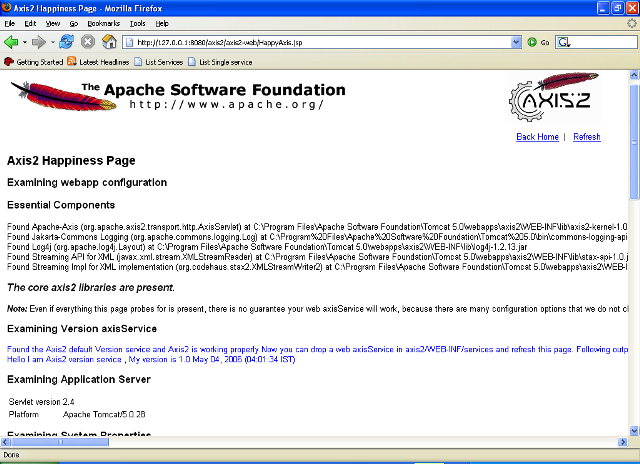
That, for the curious, is precisely why Apache Axis has  two features that I added based on my experiences here.

1. a health page, happyaxis.jsp.This gives the system state, returns 200 if happy, 500 if not -for the things upstream to react to- and is designed for humans to parse too.


2. The other feature, which is much less obvious, is that Axis can include the hostname in an AxisFault; with its addHostnameIfNeeded() method, a hostname may be returned to the caller. If enabled, you can push down some of the fault diagnostics to the clients, as people phone you up saying "I am getting failures from 'host4'", rather than them phoning you up saying "One request in eight is failing". Your remote automated liveness tests submitting reference work will now let you track down this problem without waiting for the call -or looking at the request logs to see which box has the problems. In a virtual world, rm that VM.

Anyway, the key points are this.
  1. Random distribution of workload is both simpler to implement, and somewhat resilient to some failure modes that convert to shorter request queues.
  2. Adding diagnostics to error responses aids in tracking down problems.
On reflection, I think it was that project where my obsession with useful network diagnostics came from.

Update: I've thought of another way to identify an overloaded worker node.
  1. Have each worker node declare its (moving) average service interval from accepting onto the queue to completion.
  2. Have the front-end servers maintain a moving average of the service interval declared by the last few worker nodes given work.
  3. The front end servers pick a worker node at random, as before.
  4. Include a query of the service interval & queue depth into the request forwarding protocol. The front end servers connect to a node in the back, ask it's for it's service interval, then decide whether or not to forward the request.
  5. The front end node can then implement a local policy for job submission that takes into account the current quoted service interval of the selected worker node in comparison with its moving average of job submissions. If the interval is significantly higher, the front-end node may choose to try another worker node to see if its interval is significantly less than that of the first node probed. If so, work could be sent there -and the moving average updated.
This approach doesn't add any more communications if all is working well (the load info can go into the first TCP ACK packet), and is entirely distributed. It's also a very simple evolution of the random distribution strategy.

[photo: a giant lizard made out of old CDs on a building in Madrid]

2013-01-25

Spec vs Test

Moored to a bollard


One of the things I've been busy doing this week is tightening the filesystem contract for Hadoop, as defined in FileSystemContractBaseTest : there are some assumptions in there that are clearly "so obvious" it wasn't worth testing.
  1. that isFile() is true for a file of size zero & size n for n>0
  2. that you can't rename a directory to a child dir of depth 1 and depth n>1
  3. that you can't rename the root directory to anything
  4. that if you write a file in one case, you can't read it using a filename in a different case (breaks on local for NTFS and HFS+)
  5. that if you have a file in one case and write a file with the same name in a different case, you have two files with different case values.
  6. that you can successfully read a file where the byte range can be in 0-255.
  7. That when you overwrite an existing file with new data, and read in that file again, you get the new data back.
  8. You can have long filenames and paths
Of these tests, #1 and #7 are directly related to some problems I've encountered in collaborating on implementing a Hadoop Filesystem for OpenStack, in collaboration with Rackspace and Mirantis. #1 -OpenStack Swift doesn't differentiate a dir with no children from an empty directory -they are both 0-byte objects which become directories when there is >1 objects with a path name under that object's name. #2: we don't eventual consistency here.

The others? Things I thought of as I went along, looking at assumptions in the tests (byte ranges of generated test data), and assumptions so implicit nobody bothered to specify them: case logic, mv dir dir/subdir being banned, etc. And experience with Windows NT filesystems.

This is important, because  FileSystemContractBaseTest is effectively the definition of the expected behaviour of a Hadoop-compatible filesystem.

It's in a medium-level procedural language, but it can be automatically verified by machines, at least for the test datasets provided, and we can hook it up to Jenkins for automated tests.

And when an implementation of FIleSystem fails any of the tests, we can point to it and say "what are you going to do about that?"

If there is a weakness: dataset size. HDFS will let you create a file of size > 1PB if you have a datacentre with the capacity and the time, but our tests don't go anywhere near that big. Even the tests against S3 & OpenStack (currently) don't try and push up files >4GB to see how that gets handled. I think I'll add a test-time property to let you choose the file size for a new test "testBigFilesAreHandled()"

The point is: tests are specifications. If you write the tests after the code they may simply be verifying your assumptions, but if you do them first, or you spend some time thinking "what are some foundational expectations -byte ranges, case sensitivity, etc- you can come up with more ideas about what is wanted -and more specifications to write.

Your tests can't prove that your implementation really, really matches all the requirements of the specifications, and its really hard to test some of the concurrency aspects (how to simulate the deletion/renaming of a sub-tree of a directory that is in the process renamed/deleted). Code walkthroughs are the best we can do in Java today.

Despite those limits, for the majority of the code in an application, tests + reviews are mostly adequate. Which is why I've stated before: the tests are the closest we have to a specification of Hadoop's behaviour, other than the defacto behaviour of what gets released by the ASF as a non-alpha, non-beta release of the Apache Hadoop source tree (with some binaries created for convenience).

Where are we weak?
  • testing of concurrency handling.
  • failure modes, especially in the distributed bit.
  • behaviour in systems and networkings that are in some way "wrong" -Hadoop contains some implicit expectations about the skills of whoever installs it.
I'd love to know how better to test this stuff, or at least prove valid behaviour in Java with the Java5+ memory model on an x86 part , a 1GbE ethernet between the cluster (with small or jumbo frames), & something external talking to the cluster off another network.

Suggestions?

[photo: van crashed into a wall due to snow and ice on nine-tree hill, tied to a bollard with some tape to stop it sliding any further]

2013-01-09

Hadoop Summit: Call for Papers


There's a CFP out for papers for this summer's (US) Hadoop summit.


Mt Shasta

Having reviewed one of the tracks for the forthcoming Hadoop Summit EU, we -Johannes Kirschnick, Bill de hÓra and myself- had to go through 30+ abstracts, and pick under 10 of them. That's a 2:1 rejection rate -so we had to be ruthless. Rather than pick abstracts based on author, employer, whether or not they were on the review committee (i.e. me), whether they were a world class public speaker people would willingly travel to hear speak (i.e. me), or whether they were friends or colleagues, we had one basic critera: "would this be interesting and relevant for the audience", where the audience were people who had paid to come to Amsterdam to hear about the future of Hadoop."

That translated into:
  1. Does it show the future of a core component of the Hadoop stack? (HDFS, YARN, HBase, ... )?
  2. Or : Does it show the future of a new-but-potentially essential part of the stack?
  3. Does it sound interesting?
  4. Is it going to be relevant to the audience within the next 18 months ?
That focus on near-line futures (the stuff where you'd discuss using the present tense in French), meant that some of the sessions that would be so profound they'd be memorable for decades (specifically, Hadoop: Embracing Future Hardware, by S. Loughran), had to be left out.  Which is a shame, because there were some really interesting things I'd like to hear about -but I'm not representative of the audience. Here I am, at an in-law's house in London, laptop out, headphones on with Underworld playing loud enough to avoid the whining sound coming from an 11 year old complaining that the lockdown of the other laptop and consequent upgrade to JDK 7 has stopped minecraft. The IDE is showing the code for a converged HADOOP-8545 SwiftFS Filesystem;  a terminal building Hadoop locally so that Maven doesn't decide to pull a Hadoop-snapshot from the Apache repos, even though I built one locally myself only yesterday. Today's trunk benefits from a review and commit by Suresh od my HADOOP-9119 patch, one that verifies that when you overwrite a file in the FS with a new file, you get the contents of the new file back. (Because eventual consistency may not be what you want).  My notion of "Hadoop future" is not that of people who don't have spreadsheets full of JIRA issues to hand -and with them in mind, we have had to be pragmatic about what people want to know about.

We've also had to go through those proposals and sift those more-immediate future talks based on which ones sound the best. Which was done based on the abstracts.

The better the abstract, the better rank your paper got.

Some of the talk proposals had proposals competing directly with others for the same area and theme. When that happened, the one with the most compelling abstract got in. When there were some up and coming parts of the Hadoop stack, we had to select between them, again based on the abstract"

This is important because a vague one "we will show some interesting developments in Project XYZ"  isn't going to get in based on (speaker, org). That's for keynotes. For the technical talks, we needed to know enough about the talk to decide whether or not it was interesting and compelling for the audience.

The result of that is, we hope, an excellent set of talks for the audience, even though the limited space meant that coverage of all that is going in the Hadoop world is incomplete, and there will be some late-breaking features coming along. The should be some space for lighting talks, demo sessions, and presumably when I'm loitering by the Hortonworks booth I'll give demos of what I've been doing. There will be ways to see really new stuff.

What you won't get is full talks on such topics -which is why if you are working on something that you think is excellent and compelling to the audience of the next Hadoop Summit:

Submit a proposal with a really compelling abstract

[Photo, Sunset on Mount Shasta, CA, August 26 2012 -overnight stop on our return from Crater Lake to Mountain View[


2013-01-07

Gmail account (not mine) potentially 0wned

A household security announcement:

2013-01-07 21:00 GMT Potential security breach of a home gmail account.
At or around 02:00 last night (GMT) at least five people, including myself were sent a URL by my wife.
  • As she's been in London, I've only just got access to this laptop
  • A curl of the link shows it has a javascript malware page; I haven't looked at what the contents are, but it's clearly trying to 0wn the browser.
  • It's too late to use the google account activity log to see what's up -it only goes back 12 hours.  I should have known about that feature this morning. For that reason we aren't sure what happened.
  • Her password was Bristol street name (not ours) + a number: weak entropy; it may have been brute-forced. Alternatively, it may not have come from her account at all, as not many people seem to have got it. I will look through my deleted items list and the headers.
  • Firefox and Chrome are up to date.
  • Thunderbird is up to date and not used for gmail
  • No bounce mail came into the gmail account. For that reason we believe that the message was not sent  to all addresses in the contact list. It may not have been compromised, though something did know that the five of us (at least) knew each other. This could be from some other email that is in the inbox of someone else who has been compromised.
  • There is no email in her mailbox that contains everyone's email address.
  • There's no obvious sign of contamination of gmail, such a filter to hide bounce responses that spamming everyone would inevitably generate.
  • even though flash is set to auto update, it hasn't picked up the most recent release, as the interval between emergency out of band flash updates is much less than the check rate of the flash updater. Whoever wrote it was optimistic and assumed that you'd update flash to get new features, not to stop it being one of the key attack routes for clients.
  • Java 1.6 is installed, though I disabled it on both browsers some time last year.
  • Acrobat pro is the default viewer of PDF files for firefox and thunderbird
  • the default app for  microsoft apps is the MS office suite
  • although MS word is set to check for updates weekly, it does not have the Nov 13 2012 critical update. The implication here is that MS Office automated update checking is broken.
  • we have adblock and flashblock to keep adverts out and flash pages from strangers away. Everyone should do this.
I have 3 theories.
  1. the password was gained through some brute force attack
  2. some malware gained access to the system via flash, acroread, MS office or, possibly though unlikely, Java. If this is the case, the Mac laptop has to be considered compromised.
  3. someone generated some spoofed emails.
Immediate Actions
  1. The password has been changed to a pass phrase.
  2. We have switched to 2 way authentication on google; a text is sent to the phone when logging in on a browser without the cookies, and you get device specific logins for IMAP clients. You can also generate sets of ready-to-use auth keys for use when travelling without a phone -which is enough to make me switch too.
  3. I've verified that neither gmail or google docs contains any of our credit card numbers. Apart from the last four digits of my number from an itunes receipt, all is well. Yes, I know about apple icloud's vulnerability to hacking with those digits [ http://www.wired.com/gadgetlab/2012/08/apple-amazon-mat-honan-hacking/all/ ], but there's little that can be done there -it's apple's side. If any card no was in a file visible from gmail I'd have had to revoke it via the bank.
  4. Updating the AV software, rebooting.
  5. Updating flash, acrobat, MS office.
  6. Update Java and make sure that java1.6 isn't on the box (you need to install the full JDK for this)
  7. Making Apple Preview the default PDF viewer for firefox and thunderbird
  8. maybe: installing Apache Office and making that the default viewer of MS Office apps from browsers. I suspect some end-user resistance there.
  9. Forcing proper pass phrases across all of Bina's accounts -her login password was compromised by a ten year old in 2012 so as to get extra time on the home computer. I do not consider the replacement to be much better.
If I see any signs of the laptop being compromised, it's rebuild time. The only reason I'm not doing it now is that I don't know how to do this on a mac -yet.

22:09 Update
  • Be aware that Installing Java7 re-enables java plugins, even if disabled. Turn it off in the (new) Java control panel, and then verify in the browser
  • Thunderbird picks up the whole set of installed plugins -including any newly re-enabled Java7 plugin, and flash. This is very serious, as it makes recipients vulnerable to targeted flash or Java attachs.
  • AV scanners are happy.
  • The headers show that the messages came from a different domain but were routed via gmail.
  • I didn't think google mail would do that to unauthenticated accounts -which makes me suspect it was a brute force attack
I'm concluding that the gmail login was guessed by brute force. The 2-way auth and new password should prevent this happening again, though we have to consider the contacts list and (personal) emails compromised.