Showing posts with label research. Show all posts

2016-09-30

s/macOS Sierra/r/macOS vista/

I've been using macOS sierra for about ten/eleven days now. and I've rebooted my laptop about 6+ times because the system was broken.

Two recurrent problems: failure to wake in the morning, gradual lockup of finder and transitive app failure.

Failure to wake: I go up to the laptop, hit the keyboard and mouse, nothing happens. Only way to fix: hold down the power and wait for a hard restart.

Back in 1999 I worked on a project with HP's laptop group, where we instrumented a set of colleague's laptops with a simple data collection app, then collected a few months of data. At the time this was considered "a lot of data". The result, the paper: The Secret Life of Notebooks. This showed that people tended to have a limited set of contexts, where context was defined as system setup: power, display, IP addr, and application: mail, ppt. And that people were so predictable in their use models, that doing some HMM to predict contexts wouldn't have been hard.

I ended up writing some little app which essentially did that: based on IPAddr and app (PPT, Acroread) full screen, could choose: power policy, network proxy options, sound settings (mute in meetings, etc). It was fairly popular amongst colleagues, because it would turn proxy stuff on and off for you, and know to turn off display timeouts when giving presentations; crank up the savings when on the move. When I look at Windows 8+ adaptation to network settings, or OSX's equivalent of that and the "When on battery ...", I see the same ideas. You don't get any HMM on the laptops though; for that you have to pick up an android phone and look at Google Now, something which really is trying to understand you and your habits. And, because it can read your emails, correlate those habits with emailed plans. If it really wanted to be innovative/scary it would work out who you were associated with (family, friends, colleagues, fellow students...) and use their actions to predict yours. Maybe someday.

User-wise, another interesting feature was how people viewed mail so differently when online vs offline. Offline, you'd see this workflow of outlook-> word-> outlook-> ppt-> outlook-> acroread-> outlook, ... etc, very fast cycles. It seemed uncontrolled window tabbing at first —until you realise it's peple going through attachments. Online, and people's workflow pulled in IE (it was a long time ago), and you'd get a cycle where IE was the most popular app cycled to from outlook. Email was already so full of links that the notion of reading email "offline" was dying. You could do it, but your workflow would be crippled. And that was 15+ years ago. Nowadays things would only be worse.

There was a second paper which was internal, plus circulated/presented to Microsoft. There I looked at system uptime, and especially the common sequence in the log

1998-08-23 18:15 event: hibernate
1998-08-24 09:00 event: boot

or

1998-09-01 11:20 event: suspend
1998-09-01 11:30 event: boot

That is: a lot of the time the laptop through it was going to sleep, it was really crashing.

My theory was that alongside the official ACPI sleep states S1-S5 there was actually a secret state S6, "the sleep you never awake from". Some more research showed that it was generally on startup that the process failed, and it was strongly correlated with external state changes: networks, power, monitors. It wasn't that the laptop made a mess of suspending, it was that when it came back up it couldn't cope with the changed state.

I don't know if macOS sierra has that issue: I do know that it has that problem if left attached to an external display overnight. Looking in the system logs, you can see powernap wakeups regularly (that's all displays off), but come the first user interaction event —where the displays are meant to kick off— they don't come up. This is resulting in system logs not far off from the '99 experiment

2016-09-27 22:20 powerd: suspend
2016-09-27 23:00 powerd: powernap wake
  ....

2016-09-27 23:30 powerd: powernap wake
..

2016-09-28 00:30 powerd: powernap wake
..
2016-09-28 08:30 powerd: powernap wake
..
1998-09-01 09:30 event: boot


That last one: that's me trying to use it.

I've turned off powernap to see if that makes a difference there.

That's the nightly problem. What's happened 3+ times is the lockup of Finder, with a gradual degradation of other applications as they go near its services.

First finder goes, and restarts do nothing
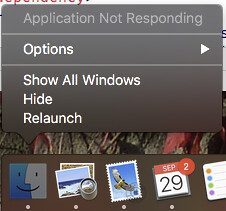
Finder not responding
Then the other apps fail, usually when you go near the filesytem dialogs, or the photo collection.
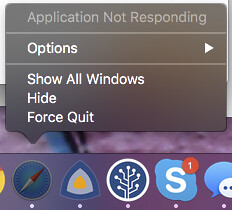
Safari not responding
As with finder, restart does nothing.

If it was my own code, I'd assume a lock is being acquired in the kernel on some filesystem resource and never being released. This is why locks should always have leases. Root cause of that lock/release problem? Who knows. I can't help wondering, though, if its related to all the new icloud sync feature, as that's the biggest filesystem change. I've also noticed that I usually have a USB stick plugged in; I'm going to go without that to see if it helps.

When i get this slow failure, i don't rush to reboot. It takes about 10 minutes to get my dev environment back up and running again: the IDEs, the terminal windows, etc, 2FA signing in to webapps, etc. I really don't want to have to do it. Instead I end up with bits of the UI keeling over, while I stick to the IDE, chrome, terminals. I had a bit of problem on Thursday evening when calendar locked up the extent I couldn't get the URLs for some conf calls; I had to use the phone to get the links and type them in.

Anyway, come the evening, after the conf calls and some S3a Scale tests, I kick off a shutdown.

And here a flaw of the OSX UI comes in: it assumes that whatever reason you are trying to do a shutdown for, it is not because finder has crashed. And it gives any application the right to veto the shutdown. You can't just select "shut down..." on the menu, you have to wait for any apps to block it, stop them and then continue. And even after doing all of that, I come in this morning and find the laptop, fans spinning away, me logged out but some dialog box about keychain access required. This is not shutting down, this is half hearted attempt at maybe shutting down sometimes if your OS hasn't got into a mess.

It's notable that Windows has some hard coded assumptions that a shutdown is caused by the failure of something. It also has, from the world of Windows Server, the concept that the user may not be waiting at the console waiting to click OK dialogs popped up by apps. Thus it has a harsher workflow.

  1. A WM_QUERYENDSESSION message comes out saying "we'd like to shut down, is that OK? Apps get the opportunity to veto the sesson end, but not if it's tagged as a critical shutdown. And of you don't service that event, you are considered dead and don't get a veto.
  2. The WM_ENDSESSION event sent to apps to say "you really are going down —get over it".
  3. There is a registry entry WaitToKillAppTimeout you can use to control how long the OS waits for applications and to terminate, WaitToKillServiceTimeout for services, and even HungAppTimeout to control how long an app has to respond to an exit menu request (WM_EXIT?) before being considered dead and so killed.
See? Microsoft know that things hang, that even services can hang, and that if you want to shut down then you want to shut down, not find out 12 hours later that it had stopped with a dialog box.

In contrast macOS Sierra has implicit assumptions that apps rarely hang, the OS services never deadlock, and that shutting down is a rare activity where you are happy to wait for all the applications to interact with you —even the ones that have stopped responding.

This may have held for for OS/X, but for macOS all those assumptions are invalid. And that makes shutdown far more painful and unreliable than it need be.

Now if you go low level and do a "man shutdown", you can see that a similar escalation process is built in there

Upon shutdown, all running processes are sent a SIGTERM followed by a SIGKILL.  The SIGKILL will follow the SIGTERM by an intentionally indeterminate period of time.  Programs are expected to take only enough time to flush all dirty data and exit.  Developers are encouraged to file a bug with the OS vendor, should they encounter an issue with this functionality.

I think from now on, it'll be a shutdown command from the console.

Anyway, because of all these problems, I do currently regret installing macOS sierra. It shipped to meet a deadline, rather than because it was ready.

macOS Sierra is not ready for use unless you are prepared to reboot every day, and are aware that the only way to reboot reliably is from the console.

2014-01-15

Greylisting - like blacklisting only more forgiving

How not to fix a car


Reading the paper  The φ Accrual Failure Detector has made me realise something that I should have recognised before: blacklisting errant nodes it too harsh -we should be assigning a score to them and then ordering them based on perceived reliability, rather than a simple reliable/unreliable flag.

In particular: the smaller the cluster, the more you have to make do with unreliable nodes. It doesn't matter if your car is unreliable, if it is all you have. You will use it, even if it means you end up trying to tape up an exhaust in a car park in Snowdonia, holding the part in place with a lead acid battery mistakenly placed on its side.

Similarly, on a 3-node cluster, if you want three region servers on different nodes, you have to accept that they all get in, even if sometimes unreliable.

This changes how you view cluster failures. We should track the total failures over time, and some weighted moving average of recent failures -the latter to give us a score of unreliability, giving us a reliability score of 1-reliability, assuming I can normalise unreliability to a floating point value in the range 0-1.

When specifically requesting nodes, we only ask for those with a recent reliability over a threshold; when we get them back we first sort for reliability and try to allocate all role instances to the most reliable nodes (sometimes YARN gives you more allocations than you asked for). We may have some allocations on nodes > the reliability threshold.
That threshold will depend on cluster size -we need to tune that based on the cluster size provided by the RM (issue: does it return current cluster size or maximum cluster size).

What to do with allocations above the threshold?
options
  1. discard them, ask for a new instance immediately: high risk of receiving the old one again
  2. discard them, wait, then ask for a new instance: lower risk.
  3. ask for a new instance before discarding the old one the soonest of (when the new allocation comes in, some time period after making the request). This probably has the lowest risk precisely because if there is capacity in the cluster we can't get that old container, we'll get a new one on an arbitrary node. If there isn't capacity, when we release the container some time period after making the request, we get it back again. That delayed release is critical to ensuring we get something back if there is no space.
What to do if we get the same host back again? Maybe just take what we are given, especially in case #3 and we know that the container was released after a timeout. It'll be above the threshold, but let's see what happens -it may just be that now it works (Some other service blocking a port has finished, etc). And if not, it gets marked as more unreliable.

If we do start off giving all nodes a reliability of under 100%, then we can even distinguish "unknown" from "known good" and "known unreliable". This gives applications a power they don't have today -a way to not trust the as-yet-unknown parts of a cluster

 If using this for HDD monitoring, I'd certainly want to consider brand new disks as less than 100% reliable at first, and try to avoid storing data in >1 drive below a specific reliability threshold, though that just makes block placement even more complex


I like this design --I just the need the relevant equations

2012-07-08

Nobody ever got fired for using Hadoop on a cluster


Over a weekend in London I enjoyed reading a recent Microsoft Research paper from Rowstron et al., Nobody ever got fired for using Hadoop on a cluster.

The key points they make are
  1. A couple of hundred GB of DRAM costs less than a new server
  2. Public stats show that most Hadoop analysis jobs use only a few tens of GB.
  3. If you can load all the data into DRAM on a single server, you can do far more sophisticated and stateful algorithms than MapReduce
They then go on to demonstrate this with some algorithms and examples examples that show that you can do analysis in RAM way, way faster than by streaming HDD data past many CPUs.
Avebury Stone Circle

This paper makes a good point. Stateless MapReduce isn't ideal way to work with things, which is why counters (cause JT scale problems), per-task state (dangerous but convenient) and multiple iterations (purer; inefficient) come out to play. It's why graph stuff is good.

Think for a moment though, what Hadoop HDFS+MR delivers.
  • Very low cost storage of TB to PB of data -letting you keep all the historical data for analysis.
  • I/O bandwidth that scales with the #of HDDs.
  • An algorithm that, being isolated and stateless, is embarassingly parallel
  • A buffered execution process that permits recovery from servers that fail
  • An execution engine that can distribute work across tens, hundreds or even thousands of machines.
HDFS delivers the storage, MapReduce provides a way to get at the data. As Rowstron and colleagues note, for "small" datasets, datasets that fit into RAM, it's not always the best approach. Furthermore, that falling cost of DRAM means that you can start predicting cost/GB of RAM in future, and should start thinking "what can I do with 256GB RAM on a single server?" The paper asks the question: Why then, Hadoop? Well, one reason the paper authors note themselves:
The load time is significant, representing 20–25% of the total execution time. This suggests that as we scale up single servers by increasing memory sizes and core counts, we will need to simultaneously scale up I/O bandwidth to avoid this becoming a bottleneck.
A server with 16 SFF HDDs can give you 16 TB of storage today; 32 TB in the future, probably matched by 32 cores at that time. The IO bandwidth, even with those 16 disks, will be a tenth of what you get from ten such servers. It's the IO bandwidth that was a driver for MapReduce -as the original Google paper points out.  Observing in a 2012 paper that IO bandwidth was lagging DRAM isn't new -that's a complaint going back to the late 1980s.

If you want great IO bandwidth from HDDs, you need lots of them in parallel. RAID-5 filesystems with striped storage deliver this at a price; HDFS delivers it at a tangibly lower price. As the cost of SDDs falls, when they get integrated into the motherboards, you'll get something with better bandwidth and latency numbers (I'm ignoring wear levelling here, and hoping that at the right price point SSD could be used for cold data as well as warm data). SSD at the price/GB of today's HDDs would let you store hundreds of TB in servers, transform the power budget of a Hadoop cluster, and make random access much less expensive. That could be a big change.

Even with SSDs, you need lots in parallel to get the bandwidth -more than a single server's storage capacity. If, in, say 5-10 years you could get away with a "small" cluster with a few tens of machines, ideally SSD storage, and lots of DRAM per server, you'd get an interesting setup. A small enough set of machines that a failure would be significantly less likely, changing the policy needed to handle failures. Less demand for stateless operations and use of persistent storage to propagate results; more value in streaming across stages. Less bandwidth problems, especially with multiple 10GBe links to every node. Lots of DRAM and CPUs.

This would be a nice "Hadoop 3.x" cluster.

Use an SSD-aware descendent of HDFS that was wear-leveling aware, maybe mix HDD for cold storage, SSD for newly added data. Execute work that used RAM not just for the computations, but for the storage of results. Maybe use some of that RAM for replicated storage -as work is finished, forward it to other nodes that just keep it in RAM for the next stages in a batch mode, stream directly to them for other uses. You'd gain storage capacity and bandwidth that a single server will always lag compared to a set of servers, while being able to run algorithms that can be more stateful.

In this world, for single rack clusters, you'd care less about disk locality (the network can handle that better than before), and more about which tier of storage the data was. Which is what Ananthanarayanan et al., argued in Disk-Locality in Datacenter Computing Considered Irrelevant. You could view that rack as storage system with varying degrees of latency to files, request server capacity 64 GB at a time. The latter, of course, is what the YARN RM lets you do, though currently its memory slots are measured in smaller numbers like 4-8GB.

YARN could work as a scheduler here -with RAM-centric algorithms running in it. What you'd have to do is ensure that most of the blocks of a file is stored in the same rack (trivial in a single-rack system), so that all bandwidth consumed is rack-local. Then bring up the job on a single machine, ask for the data and hope that network bandwidth coming off each node is adequate for the traffic generated by this job and all the others. Because at load time, there will be a lot of network IO. Provided that data load is only a small fraction of the analysis -the up front load time- this may be possible.

It seems to me that the best way to keep that network bandwidth down would be to store the data in RAM for a series of queries. You'd bring up something that acted as an in-RAM cache of the chosen dataset(s), then run multiple operations against it -either sequential or, better yet, parallelised across the many cores in that server. Because there'd be no seek time penalty, you can do work in the way the algorithm wants, not sequentially. Because it's in DRAM, different threads could work across the entire set simultaneously.

Yes, you could have fun here.

People have already recognised that trend towards hundreds of GB of RAM and tens of cores -the graph algorithms are being written for that. Yet they also benefit from having more than one server, as that helps them scale beyond a single server.

Being able to host a single-machine node with 200GB of data is something HDFS+YARN would support, but so would GPFS+Platform -so where's the compelling reason for Hadoop? The answer has to be that which today justifies running Giraph or Hama in the cluster -for specific analyses that can be performed with data generated by other Hadoop code, and so that the output can be processed downstream within the Hadoop layers.

For the MS Research example, you'd run an initial MR job to get the subsets of the data you want to work with out of the larger archives, then feed that data into the allocated RAM-analysis node. If that data could be streamed in during the reduce phase, network bandwidth would be less, though restart costs higher. The analysis node could be used for specific algorithms that know that access to any part of the local data is at RAM speeds, but that any other HDFS input file is available if absolutely necessary. HDFS and HBase could both be output points.

That's the way to view this world: not an either/or situation, which is where a lot of the Anti-MapReduce stories seem to start off, but with the question "what can you do here?", where the here is "a cluster with petabytes of data able to analyse it with MapReduce and Graph infrastructures -and able to host other analysis algorithms too?". Especially as once that cluster uses YARN to manage resources, you can run new code without having to buy new machines or hide the logic in long lived Map tasks.

The challenge then becomes, not "how to process all the data loaded into RAM on a server", but, "how to work with data that is stored in RAM across a small set of servers?" -the algorithm problem. At the infrastructure level, "how to effectively place data and schedule work for such algorithms, especially if the no of servers/job and duration is such that failures can be handled by checkpointing rather than restart that shard of the job". And "we can rent extra CPU time off the IaaS layer"

Finally, for people building up clusters, that perennial question crops up: many small servers vs fewer larger servers? I actually think the larger servers have a good story, provide you stick to servers with affordable ASPs and power budgets. More chance of local data, more flexible resource allocation (you could run something that used 128GB of RAM and 8 cores), and less machines to worry about. The cost: storage capacity and bandwidth; the failure of a high-storage-capacity node generates more traffic. Oh, and you need to worry about network load more too, but less machines reduces the cost of faster switches.

[Photo: the neolithic Avebury stone circle, midway between Bristol and London]

[updated: reread the text and cleaned up]

2012-02-17

The datacentre is the new laptop


Sepr on CK1 at PRSC

HP has just announced its forthcoming Gen 8 servers. Rather than go on about the usual stuff: CPUs, I/O bandwidth etc., or even the trend to put solid state storage off the PCIx bus, what's interesting to me is this: the servers are explicitly designed to be part of a larger system, a datacentre.

The existing products, they are individual servers you just happen to put into racks, you just happen to hook up to a switch you've stuck at the top of the same rack. The racks may be set up into hot rack/cold rack, but that's mostly a deployment detail the servers don't care about, except in ensuring airflow is good.

This has now changed.

The Datacenter as a computer argued that the software developers need to recognise that a datacentre is the new execution platform, one with mixed availability, limited bandwidth and other concerns that could be ignored before -or at least treated as the special case of "distributed systems", rather than what we have now: "systems". Everything is distributed.

These hardware changes mirror that. Here are some of the new concerns for both the ops team -and the applications themselves.
  1. Re-integration of Storage and Computation.
  2. Availability though replication. Less RAID-style hardware, more
    replication across machines.
  3. Inventory tracking -especially for identifying failure points, such as monitoring the history of specific batches of disks. If some appear particularly unreliable, you want to find all of them.
  4. Networking: 10 GbE is still a luxury, bonded 2x1 GbE good for availability too. Understanding network failures in data centers shows why ToR switches become the dominant network failure point in a cluster -and from a re-replication perspective, that's not ideal.
  5. Power management. Beyond just PUE, the metric of datacentre overhead, power consumption in the servers is a big concern.

The new servers then, are designed to live in this world.

Inventory They work out from the rack (don't ask me how, I don't know these things) where they are on it -information that can be propagated to the management tools so that they can be used for inventory tracking.

Networking Lots of ethernet ports. Some slow and inexpensive for management, faster ones for the application.

Power. This work here is something you can point to Chrandrakant Patel in HP Labs for. If you look at his published work, you can see a lot of it is about airflow and cooling in a datacentre. If you can improve that -as the container hosted datacentre pods can do- then your PUE is better. Why instrument the inside of the servers? It ensures that you can keep the hardware within its limits, because you have a better idea of what is going on inside. Every extra degree F, C or K you can take the air up, lets you save a lot of money over time. Yet the risk of overheating -and the cost of doing so- makes this dangerous. Knowing what is happening inside the servers give you more confidence of what's happening.

This is what the new servers enable. Which means that we are going from servers that you stack to servers that are designed to locate themselves in the racks, ideally hosted within a datacentre container that is optimised for airflow and designed to work as close to the limits of temperature as is considered safe based on the information coming out of the servers themselves.

Which is very close to what a laptop does: a box with optimised airflow and fans that come on when they feel it is important, and with a power budget that the system is designed to optimise. The datacentre is the new laptop, at least from a power and cooling perspective.


Now, what about the software? If the datacentre-level application infrastructure can get at the power, topology and network information, it could adapt itself better.

The topology information that the servers can determine could be used to dynamically generate the topology map for the cluster. It is entirely co-incidental that I'm typing this while my new topology patches are being tested in a adjacent console, but those changes (better support for topology sources other than the script runner, ability to dump the current topology) are effectively a precursor. I wouldn't do some fancy integrated java module though -better to have a topology source that just reads a java properties file and by polling for changes, can react to moving topologies. Let the management tooling generate that and it would propagate into HDFS and the RM/MR layer.

Power? If overheating is a problem, that server can be clocked back, which makes it slower. It may be better to actually tell the resource manager that there are less slots on that box, so reducing its actual workload. This could ensure that the work running in the remaining slots doesn't take longer than normal to complete.

Networking? We really need a way to get more information about the network backplane into the application -including the amount of bandwidth currently allocated to applications. Bandwidth can be a precious resource, but right now there is better tooling to manage it in a bittorrent client than there is between applications in a datacentre.

This is a challenge and an opportunity. A challenge: this information needs to be extracted and forwarded to the applications -which then need to act on it. An opportunity -it will make the applications and datacentres work better. Wave goodbye to writing topology scripts that don't work, say hello to being able to move servers around and have them the application infrastructure work out where they are. Worry less about uncontrolled backbone bandwidth use in a shared datacentre; have some policy tooling to manage it across applications. As for power, hope to see the electricity bills decrease.


[Artwork: Sepr on Jamaica Street, Stokes Croft]

2011-11-16

Disclaimer: I reserve the right to not know what I'm talking about

break time

There have been some links to this blog with the implications that either because I am a researcher at HP Laboratiories with commit rights to a number of projects -including Apache Hadoop- then my opinions may have some value.

Not so.

Everything I say is obviously my own opinions, do not reflect those of my employer, may be at odds with corporate strategies of which I am blissfully unaware of, if I do mention corporate plans they may change on a whim, etc, etc.

I do work at HP Labs -which is a fun place to work- but think about what that means. It means that I don't do stuff that goes straight into shipping products. The code I write is not considered safe for humanity. I may talk about it, I may write about it, some may get into the field, but only after rigorous review by people who care about such things.

This makes it a bit like a university, except that I don't teach courses. Cleary I am not considered safe near students either, in case I damage thier minds.

"Oh well", people say, "he's a Hadoop committer -that must count for something?"

It does, but I don't get to spend enough time there to keep up with the changes, let alone do interesting stuff of my own ideas.

Whenever I create an issue and say "I will do this", other people in the project -Arun, Tom, Todd and others will stare at their inbox in despair, with the same expression on their faces that my family adopts when I say "I will bake something".

Because then, yes, I may come up with something unusual and possibly even tasty, but they will know that the kitchen will be left with a thin layer of flour over everything, there will be pools of milk, and whatever went in the oven went into the closest bowl-shaped thing I could reach with one hand, rather than anything designed to be used in an oven, let alone watertight. Even if I didn't use flour or milk.

Bear that in mind before believing anything written here.

[Photo:me somewhere in the Belledone mountains; French Alps. For some reason French villages never like it when people on bicycles come to a halt]