Showing posts with label mountains. Show all posts

2016-02-17

trouble ahead

It's now over a month since I outlined my 2016 plans: get fitter, do more on testability.

What's the progress?

I've got a place on the 2016 Fred Whitton Challenge, which is widely regarded as the hardest one-day "fun" ride in the UK.

Having done it in 2014, I am minded to concur


That time 4 people got helicoptered off; I have no intention of qualifying for the same transport this year.

Instead: I now have to get fit enough to do 110 miles up 30% gradients, when I'm currently fit enough to do 25-30 miles.

In 10 weeks.

2015-12-04

Remembering the glaciers: Greenland

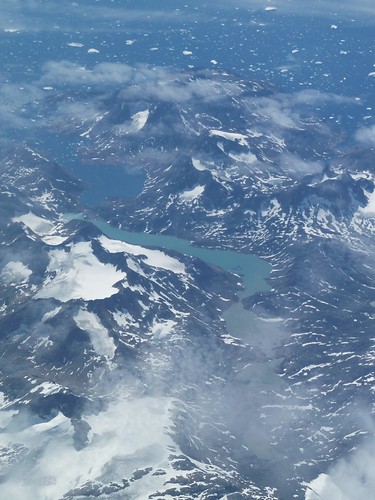
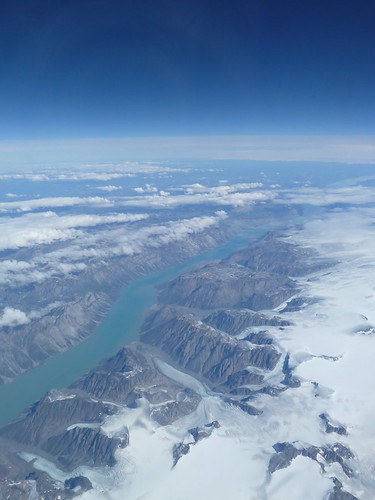
In July 2012, while wandering around on a flight to the US, I looked out the window and got to see what Greenland looks like from above.
Untitled


When this ice melts, it raises the ocean.

Untitled

And the mountains will be bare rock, as they have not been since before the ice ages began.

Untitled

There's something deeply tragic about a planeload of people, sitting in their seats, windows shuttered, watching the videos streamed to keep the populace happy —while if they chose to look up they could see the great icefields melting. Arguably, that's a description for society as a whole —and all of us in it.


2015-12-03

Remembering the glaciers: Fox Glacier, New Zealand


The southern hemisphere has its own ice. I can't find any of my 1994 Peru/Chile expedition photos, so nothing of the Southern Patagonian Ice Cap, the Torres del Paine or snow-capped volcanoes.

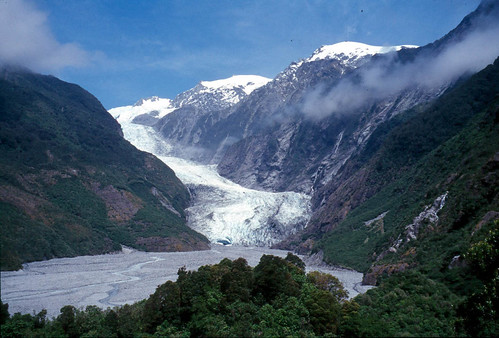
Instead, here's one from New Zealand, the Fox Glacier.

fox_glacier

This was on South Island, somewhere down the west coast, December 1998.

What's impressive here is how it comes down almost to sea level: we were staying nearby and this was a short and mostly flat walk from where we were staying. It's in the temperate rain forests of the region. The fact that the entire valley looks fairly glacial implies that its been bigger in the past -like many of the other Fjords on the island, it shows the glaciers once made their way out to a lower sea level. (the same goes for Scottish sea glens, presumably)

The whole glacier was making the sound of gently running water, right down by the terminal moraines. Apparently this glacier actually advanced between 2005-2009, but it's retreating again.

[Team: Steve, Bina]
[Photo: Fujichrome ASA100 slide (presumably) on an olympus zoom-lens compact camera I'd bought in NZ]

2015-12-02

Remembering the Glaciers: Mont Pelvoux

Mont Pelvoux, Massif des Ecrins, French Alps
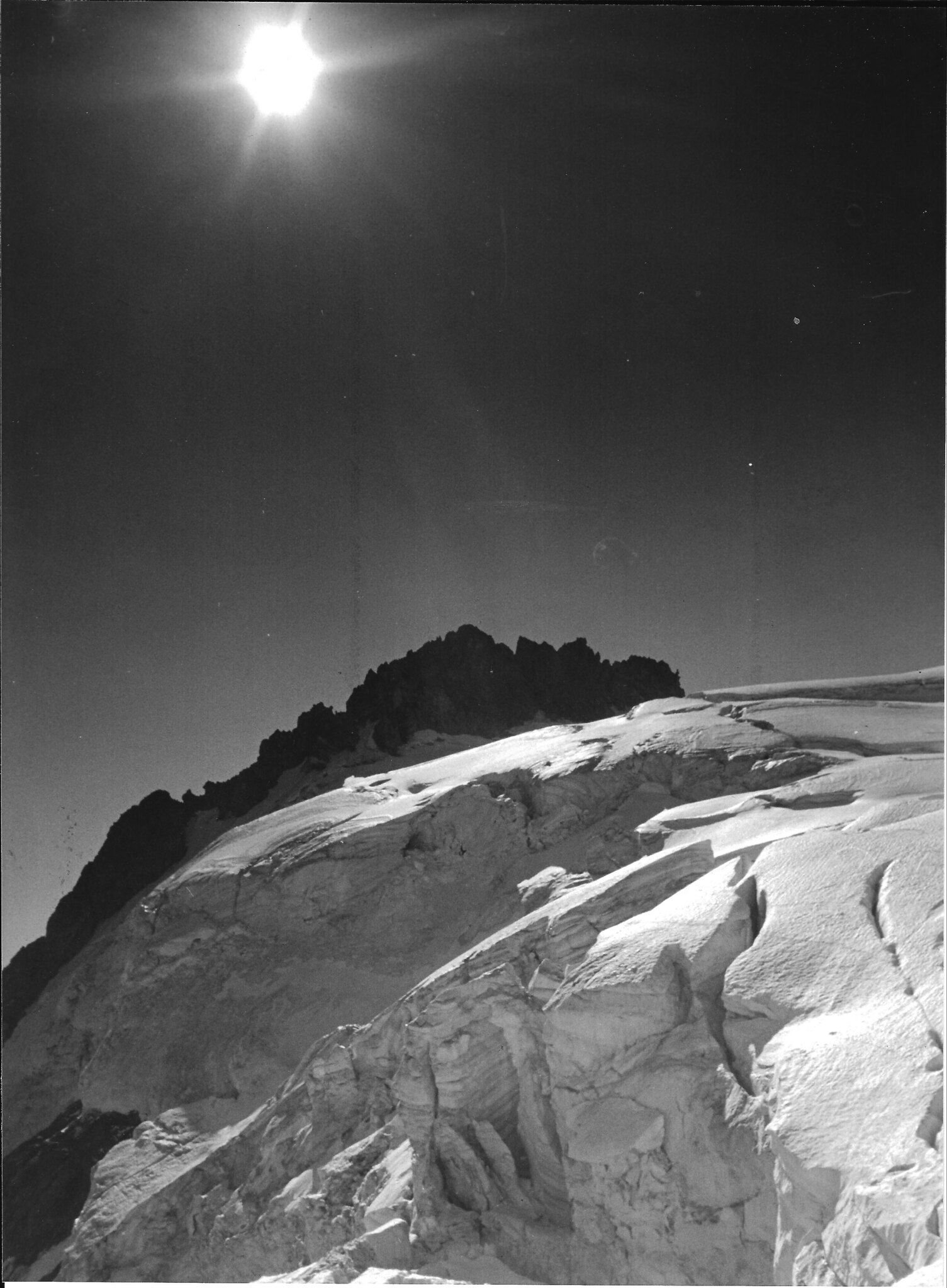
Pelvoux

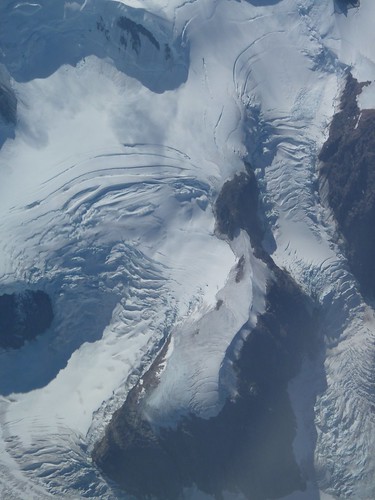
This was about two thirds through what turned out to be 14 hours on the move: out the mountain hut before 5 am, making our way up to the summit up a couloir from the south-west, continuing up the ice field, then continuing over the mountain and descending the other side. This was part of the descent, looking up at where we'd been: Glacier du Pelvoux.

Seracs are the waterfalls of glaciers; the ice may move a centimetre or two a day, but it doesn't do it smoothly: slowly the serac moves out past the rocks, building up weight until eventually its so heavy that the overhanging part —and usually a section behind— separates from the rest of glacier and starts to break off. Those cracks expand, and eventually the serac itself falls. I've never seen or even heard that, but it's something you fear. Hence you get up early and move fast.

This was the first time I'd had to descend seracs, downclimbing front pointing the crampons with you needing the clear the base as it opened up into a deeper crevasse. We used ice screws for protection, with body belays; we were already roped up for glacier work in general. The last person in the group had to make do with the in-situ protection, which was inevitably some iced up piece of wood. They were of course backed up by the people below, but even so: glad it wasn't me.

Google earth shows this peak in all its intensity.

I don't think I do this any more; not just the technical aspects, or the terrifying exposure on the way up, but 14 hours of continuous movement on the mountains is pretty brutal. My body just wouldn't cope, not given my knee hasn't recovered from its 2006 shredded tendon, and I doubt I have the endurance this or even for the 12 hour non-stop drive from the channel to the alps. I'm never going to get a chance to take this photo again.

[Participants: SteveL, Will W, ^Jim, Mark S]
[Photo: Ilford B&W with Canon Sureshot, manual D&P onto Ilford A4 paper, with manual dodge/burn for the sky]

2015-12-01

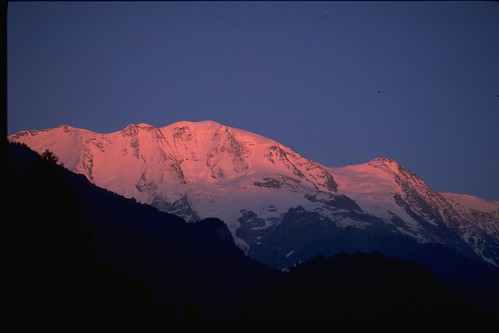
Remembering the Glaciers : Sunset over Mont Blanc

Sunset over Mont Blanc

Sunset over Mont Blanc.

From the west, obviously; Will and I had turned up with our bikes near Les Contamines and haggled over how much it would cost us to camp there. We'd already eaten, so all we were paying for was a shower. They gave us a discount in exchange for making us camp in the far corner and not tell anyone what we'd paid. Given the next two days our bathing facilities were mountain streams of meltwater a few minutes off the ice, the FFr we paid for the shower was worth it.

Wikipedia tells me that that the date was 21 June, 1997. We'd been up Col de la Columbiere that morning to catch a mountain stage of the Tour de France. Pantani won the day, with Col de Joux Plane being the big finale.

We were heading in the opposite direction: south on gravel tracks over to Lac Du Roselend, then continuing a partial bike circuit of Mont Blanc.

Imagine what this would look like without the ice? Still dramatic, but red in the sunset?

[Participants: Steve L, Will W]
[Film: Fujichrome 100ASA slide+ Canon Sureshot compact]

2012-12-21

Death by Snow

The NY Times has one of the most beautiful HTML5 web articles to date, Snow Fall.

Beyond the shine, the story is about a group of skiiers getting avalaunched on a gully on the back side of Steven's Canyon ski resort in the Cascades. The Cascades being famed and treasured for the large volumes of (heavy) snow that it can get dumped on in a 24 hour period -a metre a day for a number of days in a row sometimes.

In the story, a group of skiers went down the "tunnel creek" after fresh snowfall onto that from two weeks previously.
By morning, there would be 32 inches of fresh snow at Stevens Pass, 21 of them in a 24-hour period of Saturday and Saturday night.
That was cause for celebration. It had been more than two weeks since the last decent snowfall. Finally, the tired layer of hard, crusty snow was gone, buried deep under powder.
Given  that you know this a new article where the outcome is not good, you can look at that say "about a metre of fresh snow on a layer which would have frozen together on the surface over the previous two weeks", and immediately conclude what's going to happen: that fresh snow isn't going to bond to the previous layer, creating a shear point that's just waiting to trigger.

skyline

That doesn't make the rest of the story any better -it's a brutal documentary of what happens when snow does what it often does after a big snowfall: slides down the mountain.

Off piste skiing isn't skiing, it's winter/spring mountaineering with skis on. Skis that give you speed, but also bias you towards going on the snowy areas, not the rocky bits. Usually it can be great fun -but it puts you right where avalanches happen.

This article is awful for anyone to read -but if you've been into winter and/or ski mountaineering it's worse: its a documentary of what's happened to friends of yours, and what could happen to you.

[photo, ski randonne work in Belledone Range, French Alps, 1994? Skis: Volkl. Camera Canon. Film and Paper: Ilford ]